
Summarize with AI
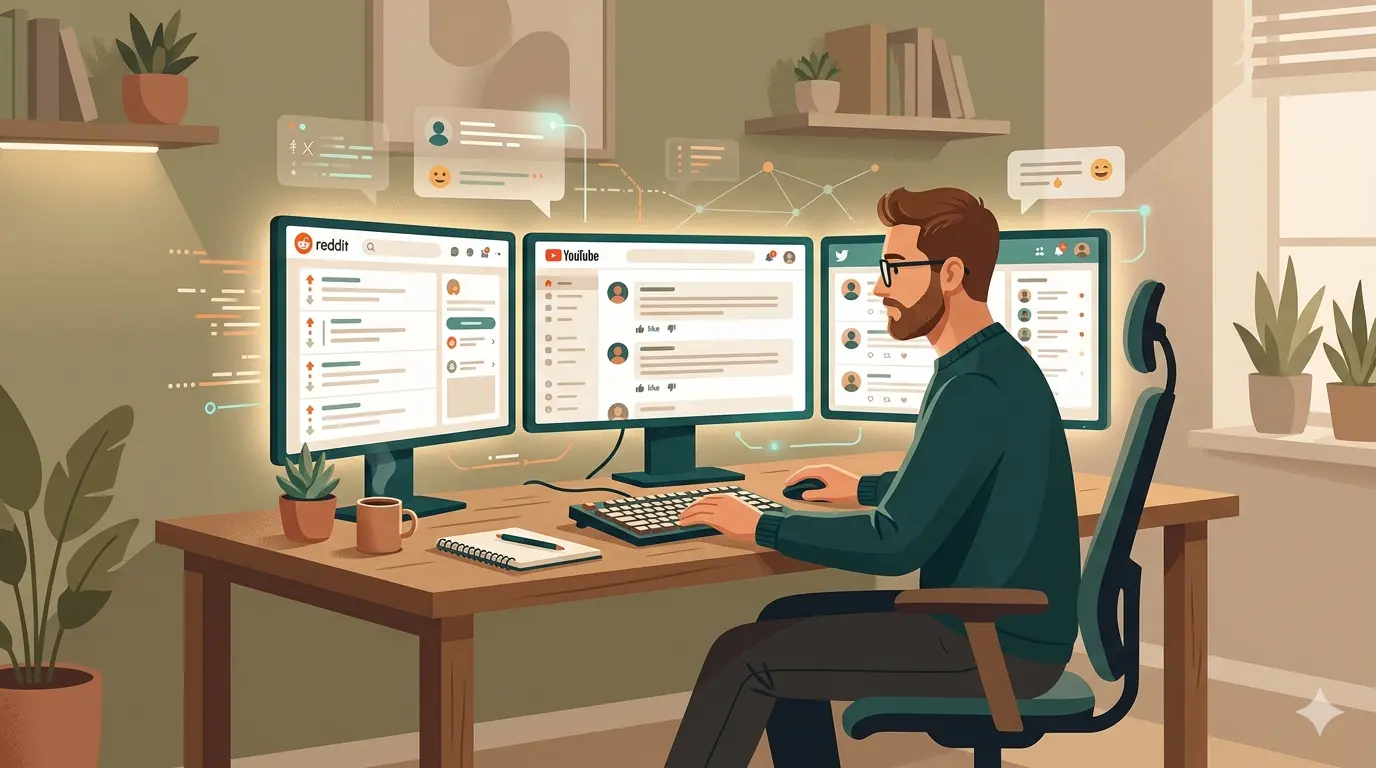
Your future customers are complaining about their problems right now. In public. For free. Most founders never see it because they're waiting to run customer interviews — but you can't interview customers you don't have yet.
The good news: you don't need a single user to start finding real customer pain points. Every community platform is an archive of unfiltered frustration, and knowing where to look turns market research from a six-hour Reddit spiral into a repeatable, 30-minute workflow.
This guide covers what a pain point actually is, where the five channels are that surface them organically, real examples from this week, and how to turn raw complaints into decisions you can act on today.
What Are Customer Pain Points? The 4 Types
A customer pain point is a specific, recurring problem someone describes having with a product, process, or workflow — one they'd pay to have solved. Pain points cluster into four types, and most real complaints combine more than one.
| Type | What it looks like | Example quote | Where it usually shows up |
|---|---|---|---|
| Financial | Overpaying, hidden costs, or an inefficiency that wastes money | "The bill creeps up every month and the basic stuff still takes way more clicks than it should." | Pricing pages, X, subreddits about the category |
| Productivity | A task takes too much time or too many manual steps | "I spend three hours a week manually exporting this to a spreadsheet." | Reddit threads, YouTube tutorial comments |
| Process | Friction working with a vendor, tool, or internal workflow | "I have to open five tabs and cross-reference two systems just to answer one question." | G2/Capterra reviews, Slack communities |
| Support | No help, or bad help, when something breaks | "I emailed support four days ago and still haven't heard back." | App Store reviews, X replies to brand accounts |
A few more examples of each, pulled from the kind of language people actually use:
- Financial: "Everything is priced around credits now, so the number keeps moving." · "We're paying for three tools that all do 80% of the same thing."
- Productivity: "I've been manually opening a dozen tabs every week just to keep up with what's happening in my space." · "Copy-pasting between these two tools is the worst part of my Monday."
- Process: "Switching between vendors means starting over — nothing carries across." · "The onboarding took two weeks longer than the sales call implied."
- Support: "Their docs don't match what's actually on the screen." · "I got a canned response that didn't address my actual question."
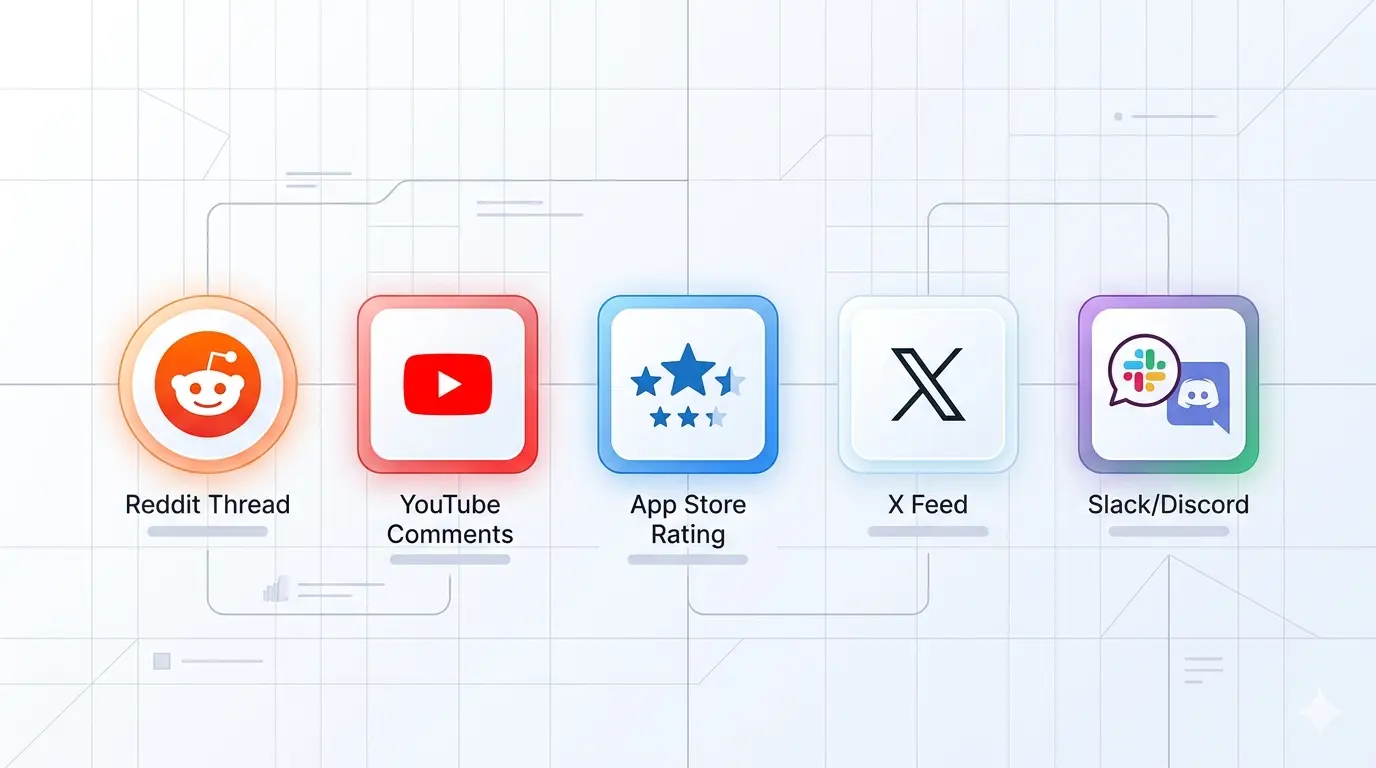
The 5 Places Real Customer Pain Points Live
Reddit Communities
Reddit is the highest-signal pain point database available to any founder, and it costs nothing but time.
The reason it works: anonymity removes the social pressure to sound reasonable. People say exactly why they cancelled, exactly which feature was missing, and exactly which competitor they switched to — with none of the diplomatic softening you'd get on a call.
Start with communities that match your ICP. For B2B SaaS founders, r/SaaS, r/startups, r/microsaas, and r/indiehackers are the obvious starting points. Then go narrower: a role- or function-specific subreddit (r/devops, r/sysadmin, r/SEO) usually surfaces more candid, specific complaints than the broad general ones, because the people posting there are describing their actual day-to-day work, not performing expertise for an audience. For a full breakdown of how to map subreddits to your ICP and build an audience profile from what you find, see the Reddit Audience Research Guide.
Once you're in the right communities, look at comment sections more than post titles. Comments are where the real emotion lives — the replies where someone describes the workaround they've been doing for months, or the reply that says "I've been looking for exactly this for two years." Posts describe a situation. Comments reveal frustration.
Frequency signal: One post saying something is broken is an anecdote. The same complaint appearing across five different threads, started by different people, at different times, is a validated pain point. Upvotes tell you how many people agreed enough to click.
If you want to skip manual subreddit discovery, the Subreddit Analytics tool shows posting frequency and engagement for any community you're considering, so you can tell an active pain-point goldmine from a dead subreddit before you invest time reading it.
YouTube Comment Sections
YouTube comment sections on competitor product reviews are one of the most underused customer research channels.
The signal is concentrated: people who watch a 10-minute product review and leave a comment are high-intent. They're evaluating options. When they complain, they're describing gaps in the market. Filter for 1–3 star reviews and read what people say is missing or broken.
Tutorial video comments are equally useful. When someone can't figure something out, they say so. Their confusion is your product opportunity.
Search [competitor name] review or [category] tutorial and spend 20 minutes reading comments. You'll surface real frustrations from real users faster than any survey.
App Store and G2 / Capterra Reviews
For B2B SaaS, G2 and Capterra one-star reviews are a direct window into what your competitors are failing to deliver.
The format forces specificity. Reviewers explain what went wrong, what feature was missing, what made them switch. Filter by "cons" and "what's missing" across 10–20 reviews of competitor tools and you'll see patterns emerge fast.
For consumer products, App Store reviews at 1–2 stars work the same way. Sort by most recent to catch emerging complaints before competitors have responded to them. For a broader playbook on finding B2B customers across platforms beyond review sites, see 10 Proven Methods to Find B2B Customers on Social Media.
X (Twitter) Threads and Replies
Search on X for phrases that signal frustration or unmet need:
[category] is frustratingI wish [tool] couldwhy is there no [thing]anyone know a way to
Quote-tweets are especially valuable — they surface secondary reactions to problems, which often reveal adjacent pain that the original post didn't capture. Low-follower accounts tend to complain most honestly; they're not performing for an audience.
The weakness of X for research is that threads are short and context-thin. Use it to detect signals, then verify the pattern on Reddit or review sites where people go into more detail.
Niche Slack and Discord Communities
Invite-only communities have higher signal than public platforms for one reason: the barrier to entry filters for people who are serious about the topic.
In a Slack community built around a specific workflow or industry, members share raw frustrations they'd never post publicly. Problems are described in context. Workarounds are shared as solutions. That context is gold for product research.
Many niche Slack communities have searchable history. Use it. Search for problem-adjacent phrases in #general, #tools, or #help channels and you'll find dense concentrations of honest pain.
If the community hosts work in public — troubleshooting threads, shared screenshots, live workflow questions — watch how members actually do things. The friction they've normalized, and never think to complain about explicitly, is often the highest-value pain to solve. People rarely articulate the thing they've been doing manually for two years. They just do it.
Real Examples: Pain Points by Niche This Week
Everything above is a method. Here's what it actually turns up, pulled straight from Reddinbox's own weekly pain-point reports for three live niches, generated the week of September 21–27, 2026.
- "I'm trying to figure out how to get an AI/ML job as a fresher, but the more I study, the more I feel like it's never enough." — r/learnmachinelearning
- "This is annoying because you cannot simply switch between agents without starting over. We get locked into a single provider." — Hacker News
- "ComfyUI has no MLX support, so everything goes through the PyTorch MPS backend... you spend a lot of time moving tensors that never needed to move." — r/StableDiffusion
- "I really don't want them using this same role when working with AI agents, as I'd like to limit the agents' blast radius." — r/devops
- "Letting AI generate massive chunks of unvetted code is quickly piling up technical debt." — r/webdev
- "If you are falling out of love with React, I highly recommend you try Svelte (or Vue, Solid, etc.)." — r/webdev
- "I mean actual case studies, experiments, real results, ranking changes, tests... not just basic SEO articles." — r/SEO
- "Everything is priced around AI credits now, so the bill creeps up every month, and the basic stuff still takes way more clicks than it should." — r/DigitalMarketing
- "I was stressing out daily trying to keep endless posts going across every single platform just to keep up with a monthly calendar." — r/SocialMediaMarketing
These reports update every week and cover 10 niches total — this is the same underlying data the rest of this guide is teaching you to find manually, already collected, scored by frequency, and linked to source.
How to Turn Raw Complaints Into Usable Insights
Look for Frequency, Not Intensity
The loudest complaint isn't necessarily the most common one. A single post with heated language is anecdote. Ten people calmly expressing the same frustration across separate threads is signal.
Before you act on a pain point, count how many times you've seen it stated independently. Set a minimum threshold of three independent sources before you treat it as real. Five is better.
Upvotes, likes, and reply agreement help here. A comment with 200 upvotes that says "I hate how X works" is telling you that 200 people felt strongly enough to click — that's the closest thing to frequency validation you'll find in unstructured community data.
Capture Their Exact Words — Not a Paraphrase
This is the most important step most founders skip.
When someone describes their exact workflow frustration, copy that sentence verbatim. Don't summarize it as "user finds manual research tedious" — the specific phrasing is what matters.
The exact phrasing is what matters. Those are the words that belong in your landing page headline, your onboarding copy, your email subject lines. When you reflect customers' exact language back at them, conversion rates climb because they feel seen. Paraphrasing loses the emotional charge that makes copy resonate.
A Pain Point Research Template
Instead of a vague running doc, use a fixed set of columns so every entry is comparable and nothing gets lost:
| Source | Verbatim quote | Type | Frequency | Workaround | Link |
|---|---|---|---|---|---|
| r/devops | "I'd like to limit the agents' blast radius" | Process | 8 mentions | Manually scoping IAM roles per agent | source |
Fill in one row per distinct pain point, not per post — if you see the same complaint in three threads, that's one row with a frequency of 3, not three separate rows. Once you have 8–10 rows, this table is your positioning library.
Distinguish Pain From Preference
Not every complaint is a business opportunity.
Pain: "I can't do X at all" / "X takes me three hours every week and I hate every minute" / "I've tried four tools and none of them solve this."
Preference: "It'd be nice if the UI had dark mode" / "I wish the export included a CSV option."
Build for pain first. Preferences are nice-to-have features that rarely drive purchase decisions. Pain is what makes someone switch tools, pay for a new solution, or manually build a workaround they've been using for months.
The workaround is the clearest signal of all. When you see people describing a manual, cobbled-together process they've built to solve a problem — that's an unmet need with no product filling it. Build that product.
A quick test for ambiguous cases: if this problem disappeared tomorrow, would someone pay to bring it back? Time-tax pain (hours wasted weekly) and financial pain (money lost or overpaid) pass this test. Dark mode and CSV export don't. That's the line between a business and a feature request.
The Problem With Manual Research (And How AI Changes It)
The Time Tax Is Real
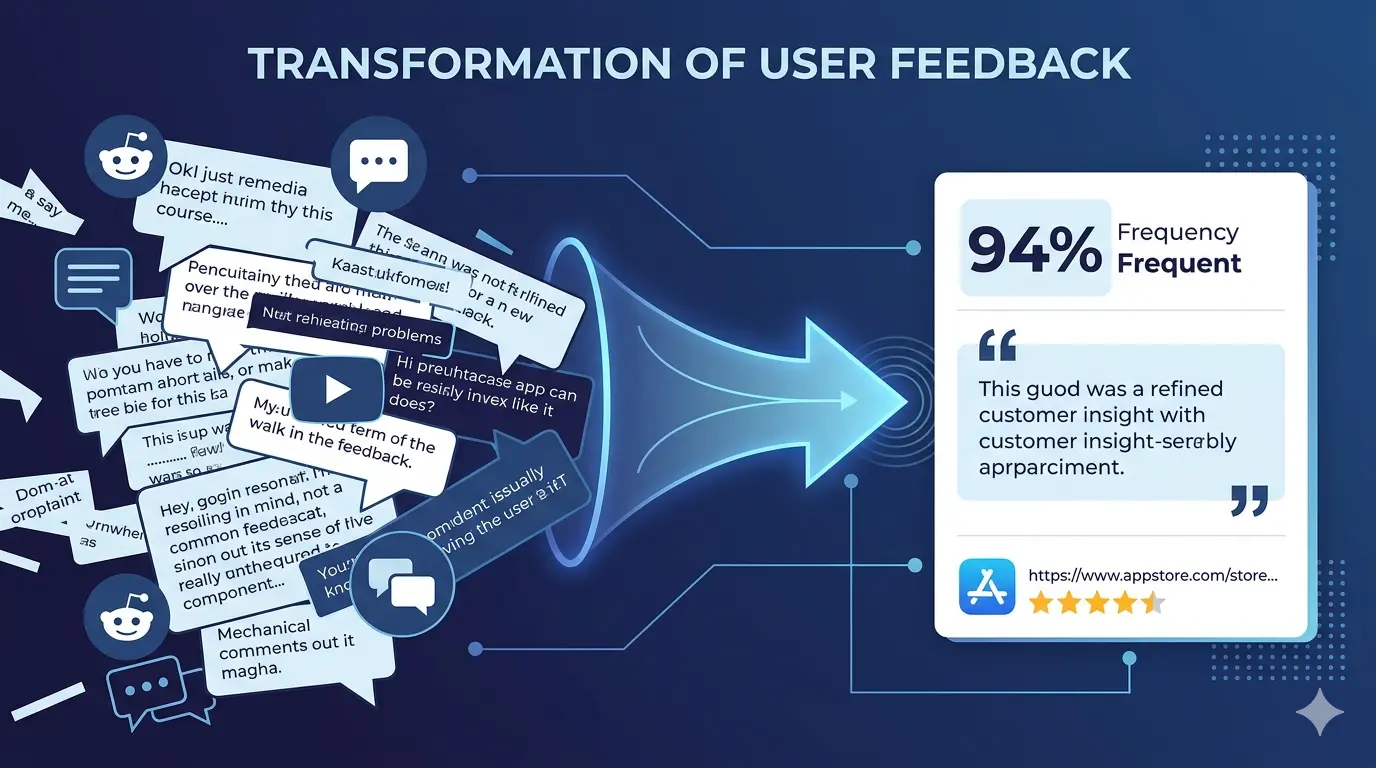
If you've tried this workflow manually, you know what it costs: a dozen tabs open, hours of reading, notes scattered across Notion, and at the end of it you're not sure if you have enough signal to draw any conclusion.
Manual research also suffers from selection bias. When you search Reddit yourself, you unconsciously look for threads that confirm what you already believe. You find three posts that validate your thesis, call it research, and move forward. That's not research — it's self-deception.
Noise Is Getting Worse
AI-generated Reddit posts and bot comments have multiplied. A single spam thread can skew your entire research session if you're reading manually and not filtering carefully. Spotting AI-generated content takes attention and experience — and even then, experienced researchers miss it.
The more you rely on manual reading, the more susceptible your research becomes to bad data.
What AI-Powered Research Looks Like
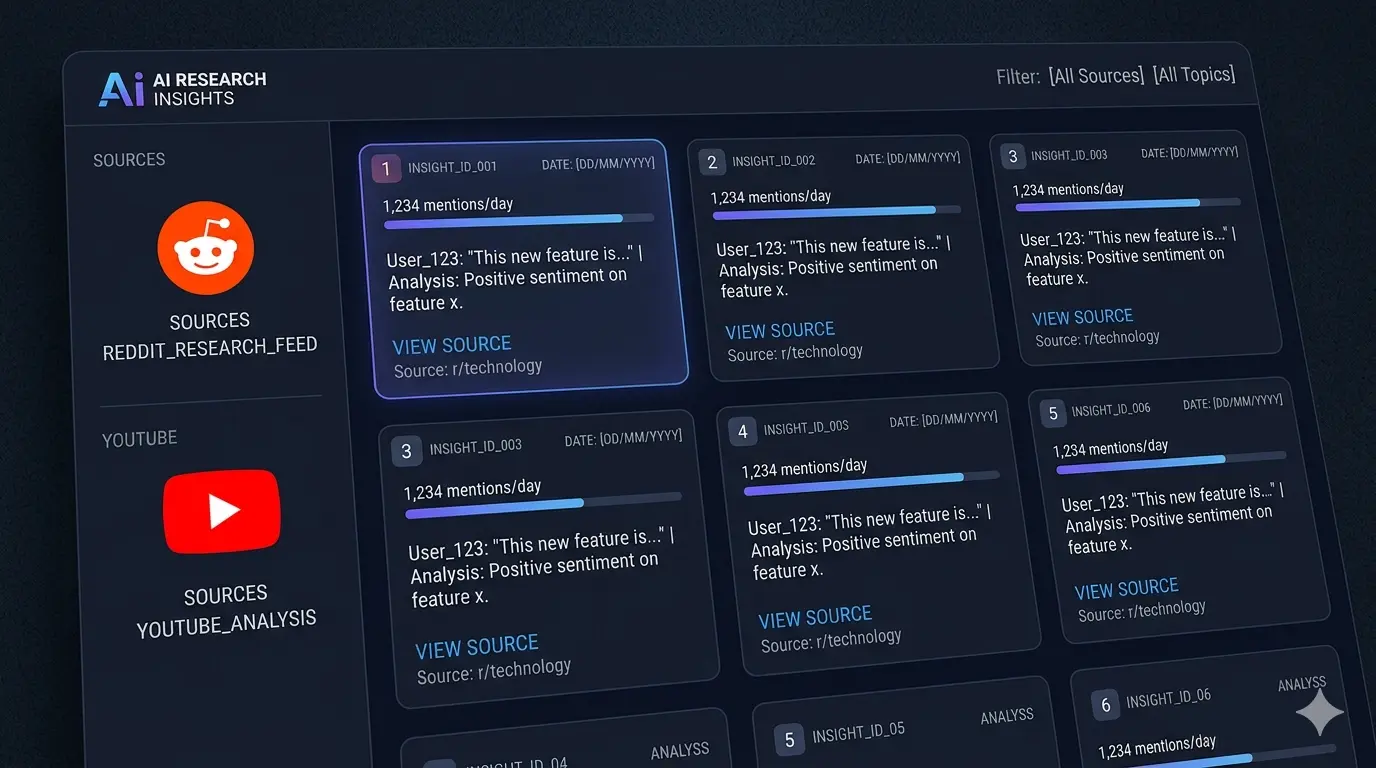
The right tool for community research does four things: it lets you describe what you need in plain language, searches across multiple communities and platforms simultaneously, filters out spam and AI-generated noise before you see any results, and returns ranked pain points with direct links to the original source posts.
That last part matters. Every insight needs to be traceable. If you can't click through to the original Reddit thread, you can't verify the data, and you can't show it to a co-founder or investor as evidence.
Reddinbox works this way — it's a research agent that takes a plain-language description of what you want to understand, searches Reddit and other communities on demand, filters out bots and low-quality posts, and surfaces ranked pain points with full citation trails. You can run this search automatically with the free pain point research tool rather than reading every thread yourself. Research that used to take three to six hours of manual scrolling is done in minutes, and the output is specific enough to act on. If you want to see how it compares to doing this research manually, see The Best Customer Research Methods in 2026.
From Pain Points to Product Decisions
Validate Before You Build
Once you have 8–10 pain points documented with frequency counts, validate the top three before touching your roadmap. If you're fully pre-PMF, How to Validate Startup Ideas on Reddit covers the full signal-reading framework for reading buying intent from community data.
Validation doesn't require interviews. Check if people are actively searching for solutions — Google Keyword Planner will tell you if "automate Reddit research" gets 1,000 monthly searches or zero. Also check the "People Also Ask" box on Google, Reddit search autocomplete, and AnswerThePublic, which all surface real queries people are typing to find solutions right now. A high-volume search query for a problem means people have accepted the pain is real and are actively looking for a way out.
Check if they're paying for workarounds: if someone built a manual spreadsheet system for a problem, they're signaling willingness to pay to solve it. That revealed behavior is worth more than any answer to "would you pay for this?" — people lie when asked hypothetically, but their time and money tell the truth.
If both conditions are true — people are searching for solutions and using workarounds — you have a validated pain point worth building around.
Use Pain Points to Write Better Copy
The fastest landing page improvement most founders can make is replacing their own language with their customers' language.
Take the most emotionally loaded phrase from your research and test it as a headline. If ten people described their problem as "I've been doing this manually for months and I hate it," your headline might be: "Stop doing it manually." That phrase will resonate in a way that "streamline your research workflow" never will.
This is the compounding benefit of pain point research that most advice skips: the output isn't just product decisions. It's the exact copy that makes someone feel seen when they land on your page.
Keep a Running Log
Markets shift. Pain points evolve. The complaint that dominated Reddit in January may be solved by February if a competitor ships the right feature. Positioning that worked at $0 MRR may need updating at $10k.
Set a recurring time each week to add new findings to your tracker. After four weeks, look for shifts: did a new pain category emerge? Did the frequency of an existing one increase? Those shifts are signals worth acting on before your competitors notice them. If you want this monitoring automated, Buying Signals runs 24/7 across Reddit, X, and Hacker News and delivers matched conversations as they happen. For a full weekly research system, see How to Use Reddit for Market Research.
Frequently Asked Questions
How do you find customer pain points without customer interviews?
Community platforms are the answer. Reddit, YouTube comment sections, G2 and Capterra reviews, X, and niche Slack communities contain millions of unsolicited, unfiltered complaints from people with no incentive to be polite. You don't need to recruit anyone or schedule a call — you need to find where your target customers vent and read at scale. The five channels in this guide are the starting point; the main skill is learning to distinguish frequency from noise.
What are the 4 types of customer pain points?
Financial (a product costs too much, or an inefficiency wastes money), productivity (a process takes too much time or too many steps), process (friction working with a vendor, tool, or internal workflow), and support (a lack of help when something goes wrong). Most real complaints combine two or more of these at once — a "this takes too long" complaint is often also a financial one, since time has a cost.
What are examples of customer pain points?
"This tool's pricing jumped and now I'm paying for features I don't use" (financial). "I spend three hours a week manually exporting this to a spreadsheet" (productivity). "I have to open five different tabs just to get one report" (process). "I emailed support four days ago and haven't heard back" (support). The real examples above show what these look like in the wild, this week.
What is the difference between pain points and needs?
A pain point is the friction someone describes right now — "this takes too long" or "I can't get this to work." A need is the underlying outcome they're trying to reach; the pain point is evidence of the need, not the need itself. Several different pain points (slow exports, manual re-entry, no API) can all point to the same underlying need (real-time data sync).
How do I know if a pain point is real or just a mild preference?
Apply the disappear test: if this problem vanished tomorrow, would someone pay to bring it back? Time-tax pain (hours wasted weekly) and financial pain (money lost, tools overpaid, revenue missed) pass this test. UI preferences — dark mode, different export format, slightly better onboarding — don't. The strongest signal is the workaround: if someone built a manual, cobbled-together process to solve a problem, the pain is real enough that they already invested time in a solution.
How many independent sources do I need before a pain point is validated?
Three is the minimum before you take a pain point seriously. Five independent sources — different people, different threads, different time periods — is better. Upvotes amplify this: a comment with 200 upvotes represents 200 people who felt strongly enough to click. One emotionally charged post is anecdote. The same complaint appearing across five separate threads, started by different users at different times, is a validated pain point.
How do you find pain points for a B2B product?
Go narrower than the obvious subreddit or search term. B2B pain points concentrate in role- and function-specific communities (r/devops, r/sysadmin, r/SEO) more than product-category ones, and in review sites like G2 and Capterra, where reviewers are specific about what a competing tool fails to deliver. See the full playbook in 10 Proven Methods to Find B2B Customers on Social Media.
How do you identify pain points in a niche or "boring" established industry?
Niche subreddits and vertical Slack communities are the best starting point. People in legacy-heavy industries often describe pain in terms of workarounds they've been running for years — "we've been manually exporting this to Excel every Friday since 2019." They've normalized the friction so completely they don't call it a problem anymore. Look for the "we've always done it this way" phrasing — that's the signal. The longer a workaround has existed, the stronger the unmet need it represents.
Can you find pain points on Reddit?
Yes — Reddit is the single highest-signal source for this, because its anonymity removes the social pressure to sound reasonable. Comments surface more than post titles: look for replies where multiple people say "same" or describe an identical workaround independently. See The 5 Places Real Customer Pain Points Live above for the full method, plus four other channels.
How do I find what people are actively searching for to confirm a problem exists?
Two methods work together. Google Keyword Planner shows monthly search volume for problem-aware queries — if "automate reddit research" gets 2,000 searches a month, that's active demand confirmation. The "People Also Ask" box, Reddit search autocomplete, and AnswerThePublic surface the exact questions people are typing to find solutions right now. Pair keyword data with community signal: if people are both searching for a solution and posting about the same frustration on Reddit, you have strong triangulated confirmation the pain is real. Once you've collected those questions, the FAQ generator is a fast way to turn those questions into an FAQ — it pulls the same kind of recurring, real questions from Reddit and Hacker News so you're not starting from a blank page.
Real customer pain points aren't hidden. They're in the communities your customers already use, stated clearly, in their own words, with frequency signals you can count.
You don't need customers to find them. You need the right channels and a system for distinguishing signal from noise.
Start with one subreddit this week. Read 20 threads. Copy the five most emotionally charged phrases you find into a document. That document is the beginning of your positioning.
When you're ready to stop doing that manually, try Reddinbox free — it runs the same research across communities on demand, filters noise automatically, and hands you ranked insights with source links in minutes.