
Summarize with AI
Most marketers find one subreddit, skim the top posts, and call it audience research. What they actually did was spend an hour confirming what they already believed.
Real Reddit audience research answers harder questions: which communities do my customers actually live in, what does their thinking look like across those communities, and how does the language they use in one context differ from another? Getting to those answers requires a deliberate approach to subreddit discovery and audience profiling, not just opening tabs.
This guide covers both in depth. If you're looking for the broader workflow that turns Reddit research into product and copy decisions, start with How to Use Reddit for Market Research.
This piece assumes you already know the basics and want to go deeper on the discovery and profiling stages specifically. If you're still in the idea validation stage, How to Validate Startup Ideas on Reddit is the better starting point.
Who Is Reddit's Audience? (Demographics)
Before you go looking for your slice of Reddit, it helps to know the baseline you're carving it out of.
Per Pew Research (last checked September 2026), 24% of US adults use Reddit. Usage skews:
- Younger: 48% of 18-29 year-olds use Reddit, versus 35% of 30-49s, 16% of 50-64s, and just 6% of adults 65+.
- Slightly male: 29% of men use Reddit versus 23% of women.
- More educated and higher-income: usage rises from 15% among those with a high school education or less to 37% among college graduates, and from 17% at incomes under $30k to 37% at incomes over $100k.
That's the general population, not your audience. Reddit's real value for research is that within this broad base, extremely specific communities exist for nearly every profession, hobby and problem — which is exactly why the discovery process below matters more than the demographic averages. A subreddit of 20,000 senior engineers will look nothing like Reddit's aggregate numbers, and that's the point.
Part 1: Subreddit Discovery
Finding the right subreddits is the precondition for everything else. The wrong communities give you noise.
The right ones give you signal that's impossible to get anywhere else.
The Discovery Stack
Treat subreddit discovery as a layered process, not a one-time search. Each layer surfaces a different type of community.
Layer 1: Reddit's native community search
Type your keyword into Reddit's search bar and filter results to "Communities." Sort by subscriber count as a starting point, but don't stop at the top results, scroll through the first two or three pages.
A subreddit with 12,000 active members in a niche vertical will often outperform a generic 400,000-member community with heavy self-promotion and low signal.
Layer 2: Google's Reddit index
Reddit's own search algorithm deprioritizes smaller, less-linked communities. Google doesn't.
Use the site:reddit.com operator to surface threads and communities that Reddit's native search misses:
site:reddit.com "subreddit for" [keyword]
site:reddit.com [keyword] community recommendations
Threads like "which subreddit is best for X?" are pure subreddit discovery gold, your target audience has already done part of the research for you.
Layer 3: r/findareddit
Post a one-sentence description of your research topic at r/findareddit and search for previous answers. Long-time Reddit users maintain an institutional memory of niche communities that no algorithm surfaces reliably.
The answers you'll find here are often the most granular and highest-quality starting points in the entire stack.
Layer 4: Subreddit sidebars and wikis
Every quality subreddit has a sidebar or wiki. The Related Communities section (when it exists) is a hand-curated map of adjacent spaces, built by moderators who know the community well.
If r/SaaS points you toward r/microsaas and r/smallbusiness, that's a stronger signal than any algorithm-driven recommendation.
Layer 5: Crosspost trails
When a post gets crossposted from one subreddit to another, follow it. A crosspost means the content was relevant to both communities.
If you see a post about B2B pricing anxiety crossposted from r/startups to r/SaaS to r/entrepreneur, all three subreddits are candidates for your research list. The crosspost trail tells you where your audience has cultural overlap.
Evaluating Subreddits Before You Commit
Not every subreddit you find is worth monitoring. Before adding one to your research list, run it through these three filters.
Size filter: 10k–500k members
Below 10k, activity is usually too sparse to find recurring patterns. Above 500k, the signal-to-noise ratio typically collapses, posts become performative, comments get generic, and heavily upvoted content reflects what sounds good rather than what's true.
The middle band is where the most honest conversations live. Check a subreddit's stats — member count, active users, posting frequency — before you commit time to monitoring it.
Activity filter: recency and comment velocity
Check when the last 10 posts were published. If the most recent post is from three weeks ago, the community is dormant regardless of its member count.
Then look at comment counts, posts with fewer than 8–10 comments rarely generate the discussion depth you need for audience profiling. Aim for subreddits where threads regularly hit 20+ comments.
Signal quality filter: moderation and flair
A well-moderated subreddit with active flairs tells you something important about its culture. r/SaaS uses flairs like "Seeking Feedback," "Marketing," and "Self-Promotion", those categories reveal how the community organizes itself and what types of conversations it treats as legitimate.
Heavy self-promotion with no flair enforcement usually means the most active users are vendors, not customers.
Building a Tiered Subreddit Map
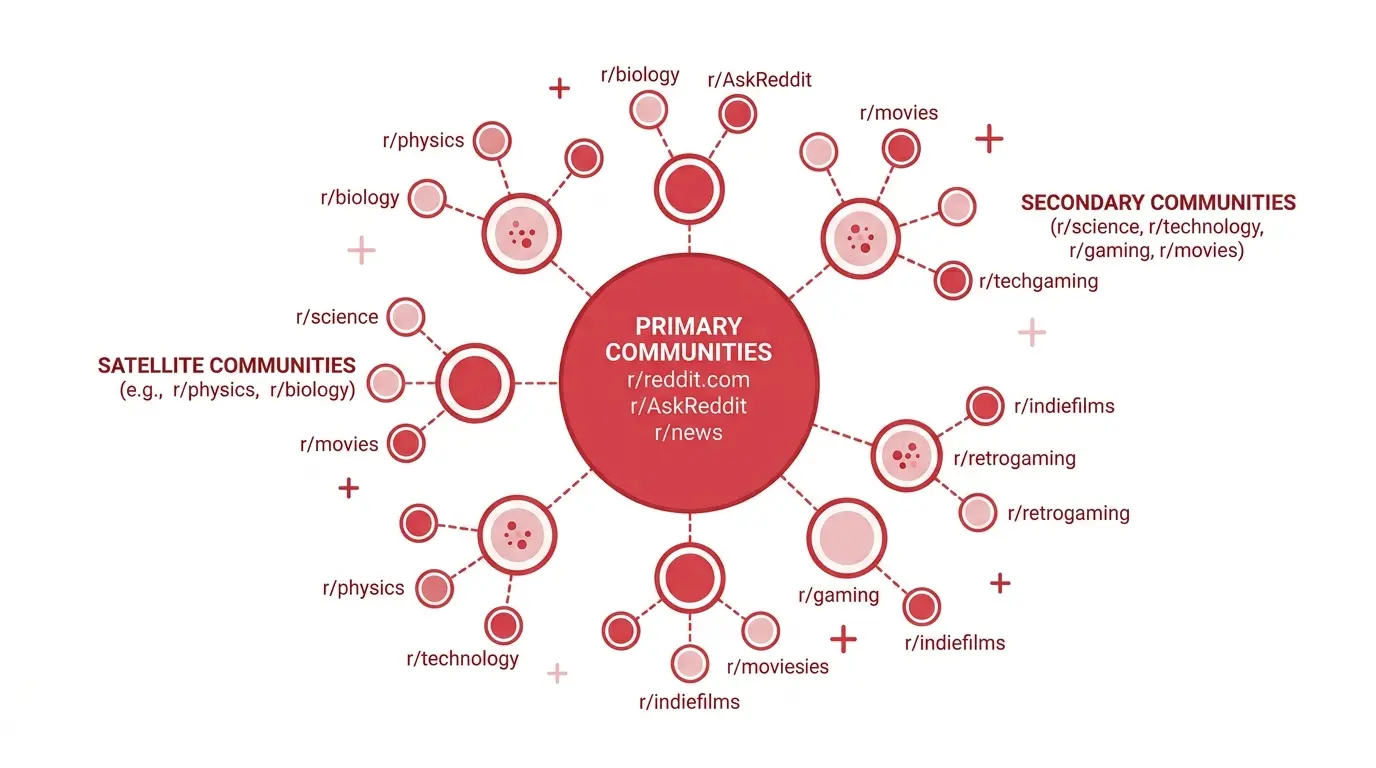
Once you've gathered candidates, organize them into three tiers rather than treating them as a flat list.
| Tier | Criteria | Purpose |
|---|---|---|
| Primary | Highest concentration of your ICP, active, high signal | Weekly monitoring, deep reading |
| Secondary | Partial ICP overlap, moderate activity | Bi-weekly scan, trend detection |
| Satellite | Adjacent context, early-stage signals | Monthly check, opportunistic finds |
For a B2B SaaS founder, a map might look like: Primary, r/SaaS, r/microsaas; Secondary, r/startups, r/ProductManagement; Satellite, r/devops, r/entrepreneur, r/indiehackers. The tiers tell you where to spend time first.
Part 2: Reading a Subreddit Like a Researcher
Once you have your subreddit map, the next job is to understand who lives in each community, not just what they post about. That requires reading a subreddit at a structural level, not just a content level.
What Top Posts Reveal About an Audience
Sort any subreddit by Top / All Time and read the first 20 posts. You're not reading for content, you're reading for patterns.
- What format gets rewarded? Case studies vs. questions vs. rants vs. how-tos. If the top posts are almost all case studies about revenue milestones, the community skews toward later-stage founders optimizing for growth. If most top posts are beginner questions, the audience skews toward earlier stages.
- What emotional register gets the most engagement? Optimism, frustration, cynicism, curiosity? The emotional tone of top posts tells you what resonates and what gets filtered out.
- Who gets celebrated vs. challenged? When someone posts a win, do comments celebrate or interrogate? A subreddit that scrutinizes success claims is populated by sophisticated practitioners. One that just upvotes the headline is full of aspirational observers.
These patterns are the cultural fingerprint of the community, and your messaging has to fit the fingerprint of the community you're targeting.
Comment Sections as Audience Portraits
If top posts tell you what the audience celebrates, comment sections tell you how the audience thinks.
Sort comments by Top first to find the responses the community collectively agreed with. Then switch to Controversial, these are responses that split the room, which almost always means the topic touches a real tension point in the community.
Inside those comments, mine for three specific signals:
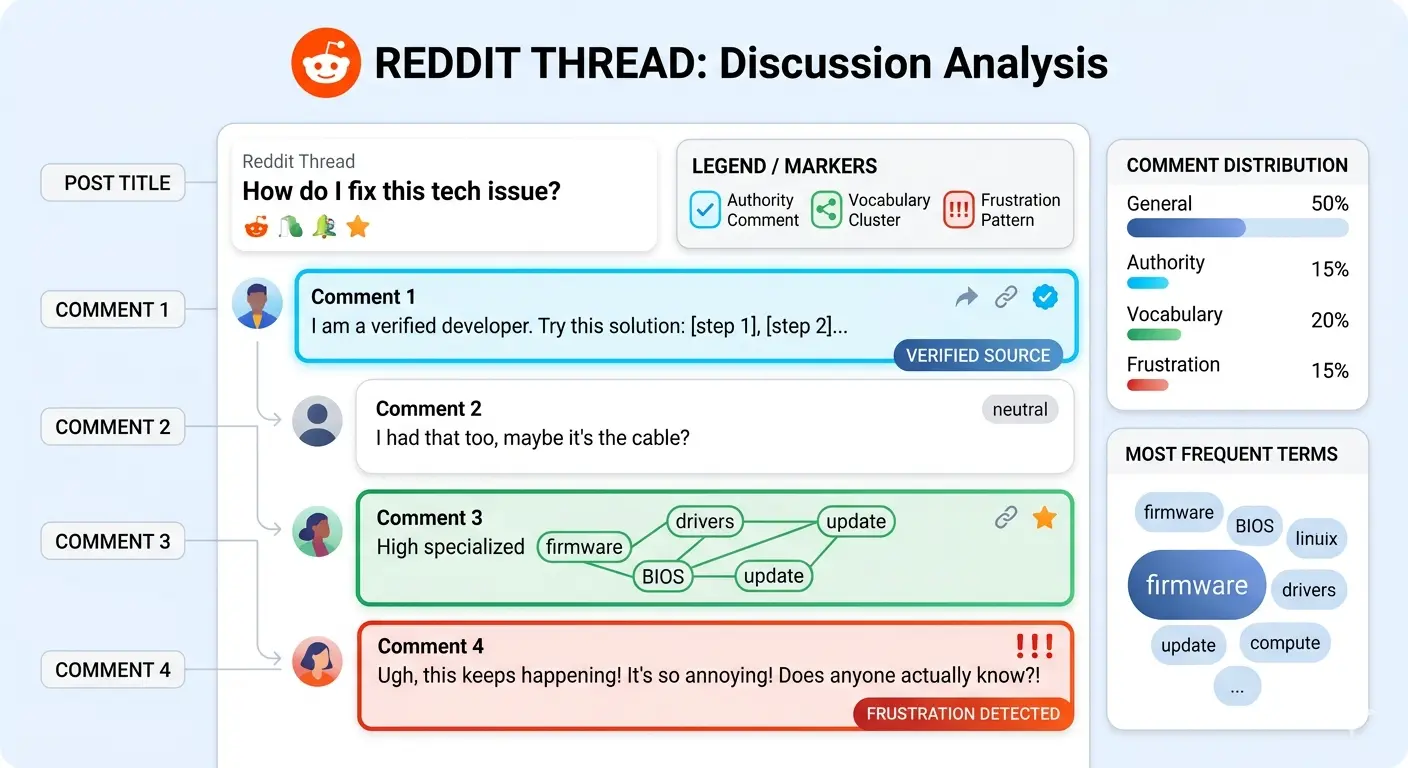
Vocabulary clusters. Make a list of terms that appear repeatedly: specific tools named, frameworks referenced, acronyms used without explanation. A community that casually references "NPS," "PLG," "LTV," and "churn cohorts" without defining them is a sophisticated practitioner audience.
One that asks "what is PLG?" is earlier in its learning curve. The vocabulary tells you the expertise level faster than any demographic data.
Unprompted frustration patterns. Comments that describe failed attempts, abandoned workflows, or "I tried X but it never worked for Y" are the most valuable data points in any thread. They reveal the gap between what tools promise and what audiences experience, and that gap is often where the best positioning opportunities live.
Social authority signals. Whose comments consistently get the most upvotes? In most quality subreddits, a small set of highly credible commenters develops informal authority, not because they're well-known outside Reddit, but because they reliably give useful, specific, experience-based answers.
These are the trusted voices in your audience's information ecosystem. What they recommend, your audience considers seriously.
Behavioral Patterns Across Posts
Reading individual threads gives you data points. Reading the pattern of threads gives you an audience model.
Track these behaviors across 30–50 posts in your primary subreddits:
- Upvote-to-comment ratio. High upvotes with few comments mean the content resonated emotionally but didn't provoke discussion. High comments with moderate upvotes mean the topic is contested. Contested topics are where your audience's unsettled beliefs live, and unsettled beliefs are where positioning opportunities exist.
- What gets removed. Check the subreddit rules, then look at locked threads and deleted comments. A subreddit that aggressively removes self-promotion has a community that views it as bad faith, meaning you'll need to earn trust before mentioning a product. One that tolerates it will interpret your research differently.
- Posting time patterns. If most high-engagement posts appear on Tuesday–Thursday mornings EST, your ICP is likely working professionals in North American time zones with enough context-switching flexibility to browse Reddit during work hours. That's an audience portrait detail that affects channel strategy, not just Reddit strategy. Check any subreddit's best posting times and engagement patterns directly with the free subreddit analytics tool instead of eyeballing timestamps manually.
Part 3: Building Your Audience Profile
With subreddits mapped and reading patterns established, you now have raw material for a structured audience profile. The goal is to produce something actionable, not a description of the audience, but a document that drives positioning, copy, and product decisions.
The Four Dimensions of an Audience Profile
A useful Reddit audience profile has four components:
- Pain intensity map, which problems appear most frequently, and how emotionally charged are they?
- Sophistication level, where does the audience sit on the expertise spectrum?
- Vocabulary bank, what exact phrases do they use to describe their problems?
- Trusted reference points, which tools, frameworks, people, and communities do they cite without prompting?
Each dimension feeds a different downstream decision. Pain intensity informs product prioritization and headline testing.
Sophistication level determines the depth and tone of your messaging. The vocabulary bank is your copy source.
Trusted reference points are your partnership and positioning anchors.
Pain Intensity Mapping
Not all complaints are equal. Build a simple scoring system: frequency × emotional charge.
Frequency is how many independent threads raise the same complaint. A pain that appears in one thread with 200 upvotes is an anecdote.
The same complaint across 8 threads started by different people at different times is a pattern.
Emotional charge is how visceral the language is. "It's a bit annoying" is low charge.
"I've been manually doing this for two years because nothing handles it correctly and I've tried everything" is high charge. High-charge language is often the most direct copy source you'll find.
Track both dimensions in a simple table:
| Pain Theme | Thread Count | Example Verbatim Quote | Avg Upvotes | Intensity |
|---|---|---|---|---|
| Manual Reddit monitoring is unsustainable | 7 | "I have 12 tabs open every Monday morning and I still miss things" | 84 | High |
| Research doesn't translate to copy | 4 | "I have insights but I don't know what to do with them" | 42 | Medium |
High-frequency, high-intensity pains are your primary positioning targets. Medium-frequency pains are supporting angles, they validate breadth but shouldn't anchor your headline.
For a broader approach to surfacing pain points across Reddit, YouTube, and X, see How to Find Customer Pain Points. If your audience overlaps with marketing or SEO, Reddinbox's weekly Marketing & SEO pain point report is a pre-built example of this same table, updated every Monday.
Sophistication Level Assessment
Read 20 comment sections from your primary subreddit and classify each one as beginner, intermediate, or advanced based on three markers:
- Tool fluency: Do they name specific tools without explaining them? Experts mention Mixpanel; beginners say "analytics software."
- Concept ownership: Do they use frameworks like "Jobs to Be Done" or "ICP" naturally, or do they treat them as new ideas requiring definition?
- Opinion confidence: Do they give recommendations with caveats, or do they hedge every answer? Confident, specific recommendations are an expert signal. Vague suggestions with heavy qualification are a beginner signal.
Knowing your audience's sophistication level prevents two costly mistakes: over-explaining to experts (patronizing) and under-explaining to beginners (confusing). Both kill conversion.
Vocabulary Bank
Your vocabulary bank is a list of the exact phrases your audience uses, not your paraphrase of them, the literal words. Pull phrases directly from upvoted comments and post titles. Group them by pain theme.
These phrases are your headline tests. The most upvoted phrasing of a complaint is often the most resonant headline you'll write, because your audience already voted it the clearest expression of their experience.
You're not writing copy from scratch, you're surfacing what they already said.
For a deeper look at how to turn research into copy and product decisions, see How to Use Reddit for Market Research.
Part 4: Cross-Subreddit Audience Mapping
A single subreddit gives you a slice of your audience. Multiple subreddits give you a model.
Where Else Does Your Audience Live?
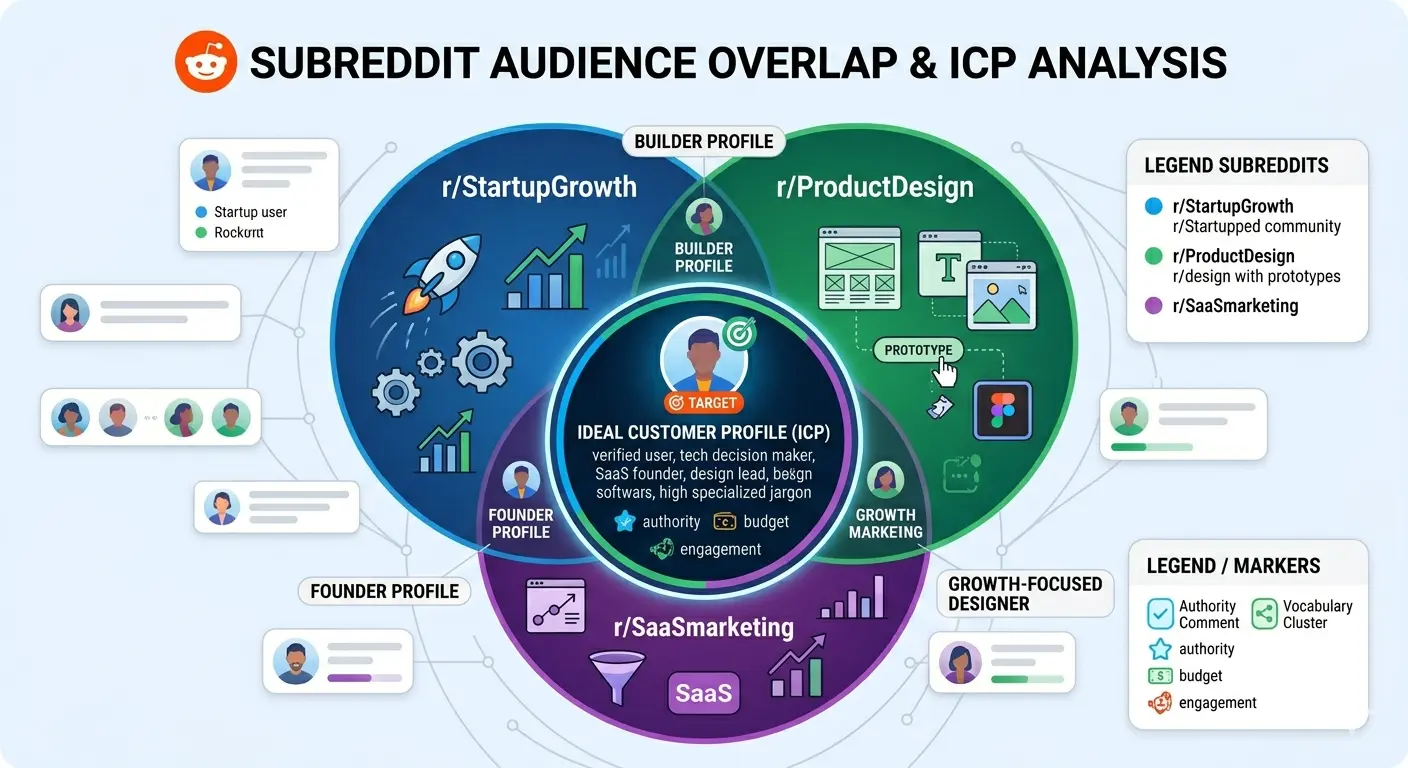
Your ICP doesn't exist only in the communities you already know about. To find where else they congregate, look at the public profiles of frequent, high-quality posters in your primary subreddits.
Reddit user profiles are public by default and show every subreddit a user has posted in. When you find a commenter who consistently gives the type of thoughtful, experience-based answers your ICP would give, check their post history.
The pattern of communities they participate in is a map of adjacent contexts: what else your audience cares about, where they look for help on adjacent problems, what they read when they're not thinking about the problem your product solves.
If five high-quality commenters in r/SaaS all also post regularly in r/ProductManagement, r/remotework, and r/entrepreneur, those three subreddits belong on your secondary tier. Your audience already lives there.
Identifying Audience Segments Within Communities
A subreddit isn't a monolith. Most communities contain multiple segments with meaningfully different needs.
You can identify them by post flair, comment tone, and the problems they raise.
In r/SaaS, for example, a post about pricing gets very different comments from founders at $0 MRR vs. founders at $10k MRR vs. founders at $100k MRR. The vocabulary shifts, the frustrations shift, the frames shift.
Recognizing these segments inside a single subreddit lets you write segment-specific messaging rather than generic copy that speaks to no one precisely.
For a broader view of finding B2B customers across multiple social channels, see 10 Proven Methods to Find B2B Customers on Social Media.
Part 5: From Audience Profile to Actionable Output
An audience profile is only as valuable as the decisions it drives. Here's how to convert each component into something your team can act on immediately.
Pain intensity map → Positioning hierarchy. Your primary pain (high frequency, high intensity) is your headline. Your secondary pains are your feature bullets. Your tertiary pains are your FAQ copy. The hierarchy of the profile becomes the hierarchy of your landing page. For more on positioning strategy, April Dunford's framework is the definitive reference.
Vocabulary bank → Copy source. Before writing any headline, check your vocabulary bank first. If three independent posters described their problem using the phrase "hours disappear into Reddit," that phrase should appear verbatim in your copy, not paraphrased. Customer research methods that rely on surveys will never surface this level of linguistic precision.
Sophistication assessment → Tone calibration. If your audience skews expert, cut the explanatory copy and lead with outcomes. If it skews beginner, explain the mechanism before you make the claim. Most landing pages fail because they're calibrated to the wrong sophistication level, and Reddit research is one of the fastest ways to identify where you're pitched wrong.
Trusted references → Partnership and positioning anchors. If your audience consistently cites a specific tool as the industry standard they hate, your positioning has an anchor. If they consistently recommend a framework you support, align your copy with that framework. Entering an existing belief is faster than creating a new one.
Reddit Audience Insights Tools
The manual process described in this guide, subreddit discovery, comment mining, profile building, takes significant time when done at scale. A single subreddit tier is manageable; five primary communities across two research topics is not.
- Reddinbox — a research agent that runs the discovery and profiling workflow in this guide automatically: it surfaces relevant subreddits, filters out spam and bot-generated posts, and organizes pain points by frequency with links back to the original threads. The value isn't speed for its own sake, it's running this process across multiple topics simultaneously without the signal degrading as you spread your attention thin.
- Subreddit analytics — free, instant member count, activity level and posting-time data for any subreddit, for the size and activity filters in Part 1.
- Subreddit finder — free discovery tool that layers on top of the manual discovery stack above.
- Sentiment analysis — a free, quick read on how a subreddit or thread feels about a topic, before you commit to deeper comment mining.
- Reddit thread downloader — free export of any thread as Markdown, text, PDF or JSON before it gets deleted or buried, for offline profiling work.
- F5Bot — free, passive keyword alerts across Reddit and Hacker News. Reddit's native search and Google's
site:reddit.comoperator cover the rest of the discovery layer at zero cost.
An added benefit of all of this: Reddit threads now rank prominently in Google search results, so the subreddits you research are also a window into what content your audience finds when they search for their problems.
If you plan to participate directly, not just observe, check your account's shadowban status periodically. A shadowbanned account keeps posting and commenting normally with no error, but nothing it submits is visible to the community, which quietly invalidates any engagement-based research you're doing from that account.
Research from MIT Sloan on using LLMs for customer needs identification shows why this kind of automation matters: what used to take hours of manual reading can now be accelerated while preserving insight quality.
If you're evaluating tools for this workflow after GummySearch's shutdown in late 2025, this comparison of alternatives is a practical starting point.
Frequently Asked Questions
Who is Reddit's target audience?
Per Pew Research (2024), 24% of US adults use Reddit overall, skewing younger (48% of 18-29 year-olds vs. 6% of 65+) and slightly male (29% of men vs. 23% of women), with usage rising alongside education and household income. That's the general population baseline — your specific audience is whichever subreddits match your niche, not Reddit's userbase as a whole.
How do I find my target audience on Reddit?
Run the discovery stack in Part 1 of this guide: Reddit's native community search, Google's site:reddit.com operator, r/findareddit, subreddit sidebars, and crosspost trails. Then filter candidates by size (10k-500k members), activity (recent posts, 20+ comment threads), and moderation quality before committing time to any of them.
What tools give Reddit audience insights?
For a quick manual check, the free subreddit analytics tool shows a community's size, activity and posting patterns. For ongoing, synthesized insights across multiple subreddits, Reddinbox runs the discovery and profiling workflow in this guide automatically, filtering spam and returning ranked, sourced pain points.
How many subreddits should I monitor actively?
For a one-person team doing this manually, two to three primary subreddits is the sustainable upper limit for weekly deep reading. Secondary and satellite tiers can be checked bi-weekly or monthly at a surface level.
More than that without tooling means either your reading gets shallower or your cadence collapses.
How do I know if a subreddit's audience actually matches my ICP?
Check three things: the vocabulary complexity in comments, the types of questions asked in the most-upvoted posts, and the job titles or roles people volunteer when giving context ("as a growth engineer at a 20-person startup..."). When those three signals consistently match your ICP definition, the subreddit is a match.
Can I use this same approach for non-Reddit communities?
The subreddit discovery and profile-building framework transfers reasonably well to Discord servers, Slack communities, and niche forums. The main difference is access, many of those require membership or approval, whereas Reddit is publicly readable.
The profiling methodology (vocabulary, pain mapping, sophistication assessment, trusted references) applies regardless of platform.
How often should I update my audience profile?
For early-stage products in fast-moving categories: quarterly. For more stable markets: twice a year.
Set a calendar reminder and re-run the discovery stack each time, new subreddits emerge, existing ones shift character, and audience sophistication level in a category tends to rise over time as the market matures.
How long does a proper Reddit research session actually take?
A focused session on one primary subreddit takes 45–60 minutes when you have a specific research question. The breakdown: 15 minutes on subreddit evaluation, 20 minutes on top post analysis, 15–20 minutes on comment mining and note-taking.
The mistake most people make is open-ended browsing without a specific question to answer. Start with one question ("what do SaaS founders complain most about around pricing?"), run the process, and stop. A weekly cadence across two primary subreddits runs about 90 minutes total — manageable for a solo founder.
Do B2B executives and decision-makers actually use Reddit?
Senior decision-makers are underrepresented on Reddit relative to the general population, but they're present in specific professional subreddits. r/SaaS, r/ProductManagement, r/devops, and r/ExperiencedDevs regularly surface posts from directors, VPs, and founders describing real operational problems.
The signal to look for isn't job titles — it's problem specificity. Someone describing a $200k procurement bottleneck in exact procedural detail is almost certainly a decision-maker, regardless of whether they state their role. Sophisticated vocabulary clusters (see Part 2) are a more reliable indicator than any demographic filter.
How do I research on Reddit without risking a ban?
Pure research mode carries zero ban risk — you're reading public posts, not interacting. The risk starts when you transition from observation to participation, specifically when you drop links or mention your product too early.
If you do engage, contribute genuine value first: answer questions in your area of expertise, participate in threads unrelated to your product, and only mention what you've built when it's directly relevant and adds something the thread is missing. Most subreddit bans come from accounts that skip straight to self-promotion. The audience profiling workflow in this guide is entirely read-only — use it to understand the community before you ever consider posting.
Understanding a community before participating is also an important part of a successful Reddit SEO strategy, helping businesses identify relevant discussions, build credibility, and create meaningful engagement before pursuing broader SEO opportunities.