
Summarize with AI
Disclosure: Reddinbox, which we build, is mentioned below as the audience-intelligence layer that sits upstream of scheduling — it's not a competitor to any of the 6 schedulers on this list, and we've tried to represent each of them accurately.
Want to see this yourself rather than take our word for it? Check what real Reddit threads say about Hootsuite with the free Reddit competitor analysis tool.
Hootsuite has had no free plan since March 31, 2023, and entry pricing starts at $99/month. If you need a free scheduler, Buffer and Metricool both have genuinely usable free tiers — see the comparison table below.
If you opened your Hootsuite invoice in 2023 and did a double-take, you weren't alone. The platform killed its free plan that year and pushed entry pricing to $99/month — a move that hit legacy users with increases as high as 2,387% over time.
Three rounds of layoffs since 2022, including a 20% workforce cut in October 2025, have only added to the unease. When a tool you depend on daily starts feeling unstable, it's time to look elsewhere.
This guide covers six solid scheduling alternatives that are worth your attention — plus one angle most comparison posts miss entirely: the audience intelligence gap that no scheduler alone will fill.

Hootsuite Alternatives at a Glance
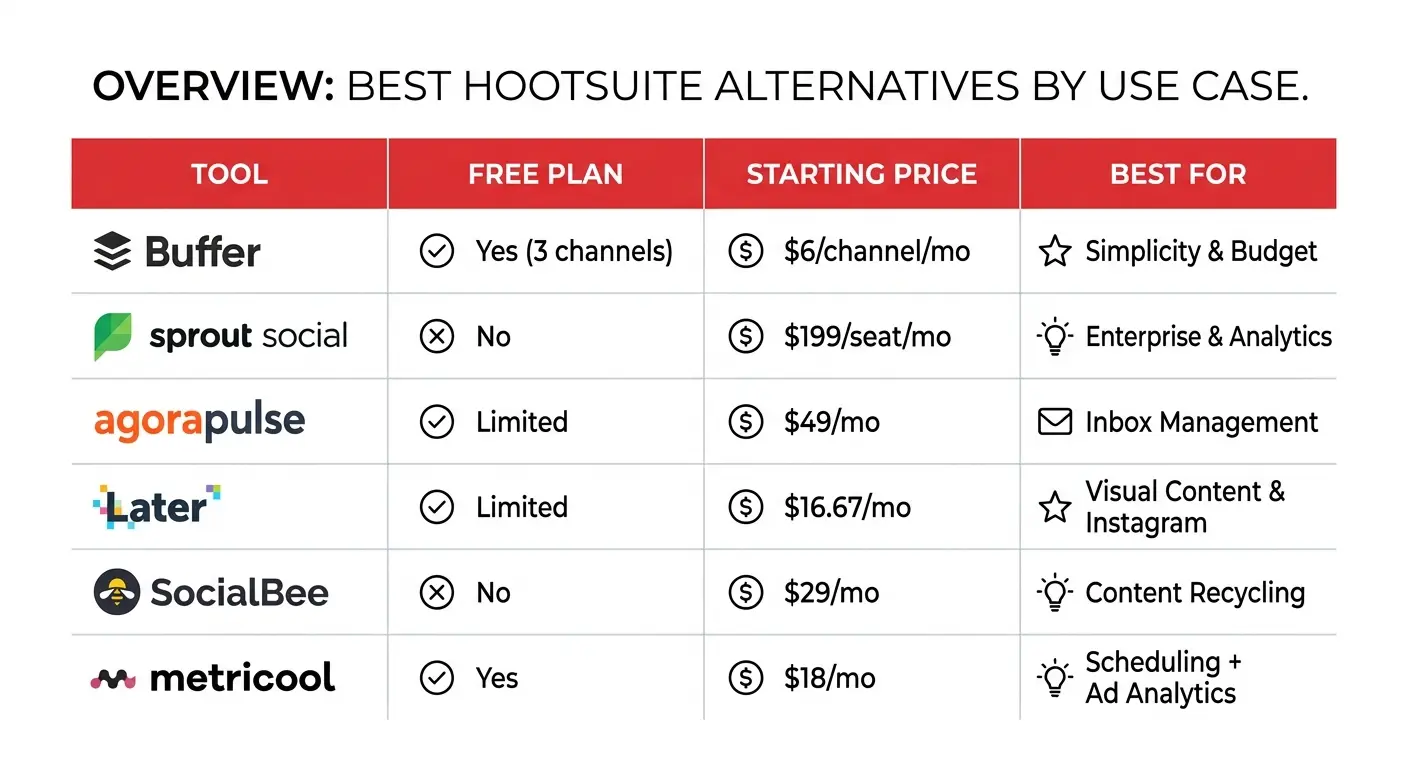
| Tool | Free plan | Starting price | Unified inbox | Listening | Best for |
|---|---|---|---|---|---|
| Buffer | Yes (3 channels, 10 posts each) | $6/channel/mo | No on lower plans | No | Simplicity & budget |
| Sprout Social | No | $199/seat/mo | Yes, most complete | Yes, add-on | Enterprise & analytics |
| Agorapulse | Limited | $49/mo | Yes | No | Inbox management |
| Later | Limited | $16.67/mo | No | No | Visual content & Instagram |
| SocialBee | No | $29/mo | No | No | Content recycling |
| Metricool | Yes (1 brand, no time limit) | $18/mo | No | No | Scheduling + ad analytics |
Use this table as a starting point, not a final verdict. The best fit depends on your team size, the platforms you manage, and whether analytics or inbox management matters more to you.
Why Social Media Managers Are Leaving Hootsuite
The pricing is the obvious starting point. After eliminating its free plan, Hootsuite now charges:
- Professional: $99/month
- Standard: $149 per user per month
- Advanced: $399 per user per month
For a team of five, that math gets painful fast — and the value proposition hasn't kept pace.
The reviews tell the same story. Hootsuite sits at 1.5 out of 5 on Trustpilot across 540+ reviews, with recurring complaints about billing surprises, auto-renewals that are difficult to cancel, and support that's hard to reach when something goes wrong.
The product itself hasn't aged well either. The dashboard feels like it was built in 2012 — because much of it was. Long-time users describe it as cluttered and slow to navigate compared to newer tools.
The social inbox is a particular frustration. Hootsuite only surfaces Facebook messages and Twitter/X DMs. Instagram comments, LinkedIn mentions, and replies across other platforms aren't part of a unified inbox — a real problem for managers handling community engagement across channels.
Social listening is available, but only as an expensive add-on, and even then it's surface-level. You get volume and sentiment data; you don't get the nuanced understanding of what your audience actually cares about.
G2 users rate Hootsuite's product direction at 7.4 — one of the lowest scores in the category. Combined with the October 2025 layoffs, there's a legitimate question about where the product is headed. That uncertainty is reason enough to start evaluating alternatives now.
What to Look for in a Hootsuite Alternative
Not every scheduling tool is worth your time. Here's what actually matters when you're making the switch:
- Scheduling that doesn't slow you down. Look for a clean UI, bulk upload or queue-based publishing, and calendar views that don't require three clicks to do something simple.
- Pricing that scales fairly. Flat-rate plans or transparent per-user pricing without hidden add-ons. If the cost doubles every time you add a team member, that's a problem waiting to happen.
- A real unified inbox. Comments and DMs across every connected platform — not just two networks. Community management shouldn't require tab-switching.
- Analytics included by default. Engagement rates, reach, and growth trends shouldn't sit behind a premium tier. If the basics require an upgrade, keep looking.
- A free plan or a trial without a credit card. You should be able to test the tool properly before committing.
With those criteria in mind, here are six alternatives worth considering.
The 6 Best Hootsuite Alternatives in 2026
Buffer — Best for Simplicity and Budget
Buffer is the most straightforward hootsuite alternative on this list. It strips social media scheduling down to its essentials: connect your channels, write your posts, pick a time, and go.
There's no dashboard bloat, no confusing nav menus, and no features you'll never use buried three layers deep. That simplicity is Buffer's strongest selling point, and it shows in the onboarding — most users are up and posting within minutes of signing up.
Key details at a glance:
- Free plan: 3 channels, up to 10 scheduled posts each — genuinely usable for individual creators or small brands
- Paid plans: Start at $6 per channel per month, the most affordable paid option in the category by a significant margin
- Analytics: Basic reach, engagement, and top posts included without an upsell
The honest weakness: Buffer's engagement features are thin. There's no unified social inbox on lower plans, so managing comments and DMs still requires you to jump between native apps.
If you're a freelancer or solopreneur who primarily needs to schedule content reliably and affordably, Buffer earns its place. If your workflow depends heavily on inbox management or deep reporting, look further down this list.
Sprout Social — Best for Analytics and Enterprise Teams
Sprout Social sits at the premium end of the market, and it doesn't pretend otherwise. At $199 per seat per month with no free plan, it's a deliberate choice — one that only makes sense if your team genuinely needs what it offers.
What it offers is best-in-class: deep analytics with AI-powered sentiment analysis, competitor benchmarking, and exportable reports that hold up in client presentations without additional formatting.
The unified inbox is one of the most complete in the industry, pulling in comments, DMs, and mentions across all major platforms into a single, manageable stream. For brand managers running high-volume accounts or agencies handling multiple enterprise clients, that alone can justify the cost.
The platform also has solid team collaboration tools and approval workflows that scale with organizational complexity.
As a hootsuite alternative, Sprout Social makes sense for mid-to-large teams or agencies where the analytics ROI is measurable. For small teams or individual managers, the price is hard to justify — you'd be paying for infrastructure you won't use. If you're scaling up and your current tool can't keep pace with your reporting needs, Sprout is worth the trial.
Agorapulse — Best for Engagement Management
Agorapulse is built around the social inbox first and scheduling second, which makes it a natural fit for community managers who spend more time responding than publishing.
The unified inbox pulls in comments, mentions, and DMs across all connected platforms and lets teams:
- Assign conversations to specific team members
- Leave internal notes visible only to your team
- Track resolution status across all open threads
AI-powered auto-responses aren't yet part of the inbox toolkit, but the manual assignment and tagging workflow is thorough enough for high-volume teams to stay on top of DMs without missing anything.
A standout differentiator is the Google Analytics integration: Agorapulse tracks which specific posts are actually driving traffic to your site, not just which ones got the most likes. That kind of attribution is surprisingly rare in this category and genuinely useful for justifying social media spend to stakeholders.
Reporting is solid overall, and the UI is notably cleaner and less cluttered than Hootsuite's. Pricing starts at $49 per month for the paid plan, with a limited free tier available.
As a hootsuite alternative, Agorapulse is the strongest option if inbox management is a core part of your daily workflow. If you're mostly scheduling content and reviewing performance weekly, you may not need everything it offers — but if you live in your social inbox, this is worth a close look.
Later — Best for Visual Content and Instagram
Later was built for visual platforms, and it shows. The drag-and-drop calendar lets you see exactly how your grid will look before anything goes live — a feature that Instagram-heavy teams and lifestyle brands genuinely depend on.
It also supports custom thumbnail uploads for Reels and video posts directly in the app, which most competing schedulers handle poorly. Instagram auto-publishing reliability is among the strongest on this list, making it a dependable choice for teams where a missed or failed post is a real problem.
If you're managing a feed where aesthetic consistency matters, the ability to preview and rearrange posts visually is more useful than it might sound.
The platform covers Instagram, TikTok, Pinterest, LinkedIn, and Facebook, and includes a Link in Bio tool that doesn't require a separate subscription. Analytics lean toward visual engagement metrics: saves, profile visits, link clicks, and reach by content type.
The free plan is available, and paid plans start at $16.67 per month, making it one of the more accessible options for creators and small teams.
The honest limitation: Later is not the right tool if Twitter/X is a significant part of your strategy. Scheduling and analytics for that platform are noticeably less robust than what it offers for Instagram or TikTok.
As a hootsuite alternative, Later earns its spot for creators, lifestyle brands, and content teams where visual presentation is the priority. For mixed or text-heavy social strategies, it's a partial fit at best.
SocialBee — Best for Content Recycling
SocialBee takes a different approach to scheduling than most tools in this category. Instead of a simple queue or calendar, it organizes content into categories — promotional, educational, curated, evergreen — and lets you set posting ratios between them.
The result is a content mix that stays intentional over time rather than defaulting to whatever you happened to write this week.
Standout features that set it apart:
- Evergreen recycling: High-performing posts can be automatically reposted on a schedule — particularly valuable for tips, FAQs, or product benefits
- AI-powered post variations: Generate multiple versions of a single idea without writing each one from scratch
- Agency plan: $82/month covering multiple client workspaces, versus $29/month for individual use
The AI caption tool produces more on-brand variations than most built-in AI writing features — useful for brands that need content volume without losing their voice.
There's no free plan, which is a genuine barrier for individual creators testing the waters. But for small agencies or content managers handling multiple brands, SocialBee's category system solves a real problem: keeping a consistent, balanced content strategy running without constant manual intervention.
If you find yourself constantly rebuilding your content calendar from scratch each month, this is the hootsuite alternative worth trialing.
Metricool — Best Free Plan
Metricool has the most generous free plan in this category by a clear margin: one brand, all major platforms, basic analytics, and no time limit. For a solo marketer or small business that doesn't need multi-brand management, that free tier is a fully functional tool, not a teaser.
Paid plans start at $18 per month when you're ready to scale.
What sets Metricool apart beyond price is the combination of scheduling, analytics, and paid ad reporting in a single dashboard. Facebook Ads and Google Ads performance sits alongside organic post data, which is unusually convenient for marketers running both channels and tired of switching between tools.
The Best Time auto-scheduling feature analyzes your audience's activity patterns and suggests optimal posting windows rather than making you guess.
The interface is clean and modern — a meaningful upgrade from Hootsuite's increasingly cluttered UI. As a hootsuite alternative, Metricool is the strongest option for marketers who want scheduling and ad analytics without the cost of two separate subscriptions. It's not the deepest tool on this list in any single category, but the breadth of what it covers at its price point is hard to beat.
Best Hootsuite Alternative for Real Estate & Local Businesses
For local service businesses — dentists, contractors, or real estate teams — Metricool or Buffer are typically the most practical fit. Both offer flat-rate plans that don't penalize you for adding accounts, don't require a dedicated social media manager to run effectively, and cover the handful of platforms (Facebook, Instagram, Google Business Profile) local businesses actually need without paying for enterprise inbox or listening features they'll never use.
The Missing Layer: What Your Scheduler Can't Tell You
Every tool covered in this article solves a real problem: when to post, how to queue content, who to assign replies to. What none of them solve is a harder question — what should you be posting in the first place?
According to the Sprout Social Index, 93% of social media practitioners say their content needs to keep pace with culture and real-time trends. The scheduling problem is largely solved. The audience intelligence problem is not.
This gap is one of the most common complaints about Hootsuite specifically. Its social listening features are frequently cited as shallow and expensive relative to what you actually get. And going the other direction — toward a heavier-duty enterprise listening platform like Brandwatch — usually means a lot more budget than the gap actually justifies. But switching schedulers doesn't fix that either — you're still left guessing what your audience cares about.
The conversations that would actually inform your content strategy are already happening. Reddit threads, YouTube comment sections, and X discussions contain unfiltered, unsolicited opinions about the topics you cover.
The problem is that manually searching Reddit threads and synthesizing them takes hours — and most teams simply don't have that time built into their workflow.
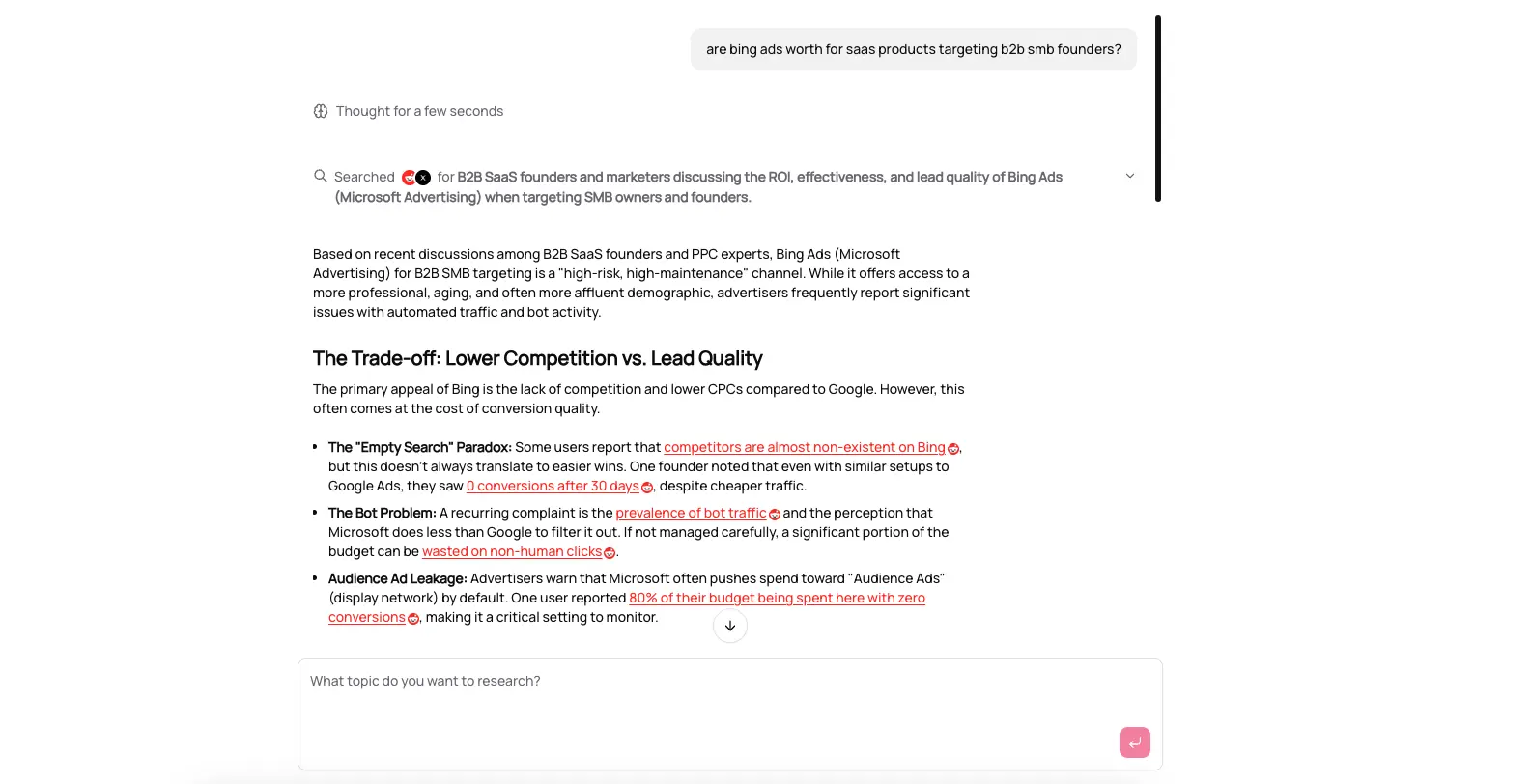
This is where Reddinbox fits. It's an AI-powered audience intelligence tool designed to sit upstream of your content calendar. You describe a research topic in plain language, and it searches Reddit, X, and more, filters out spam and AI-generated noise, and returns structured insights with direct links to the original sources.
It's useful for finding pain points your audience actually talks about before you spend time creating content nobody asked for.
The workflow looks like this:
- Research with Reddinbox to surface what your community is actually talking about
- Identify what resonates — pain points, questions, trending topics
- Create content informed by real conversations
- Schedule with Buffer, Later, or whichever tool fits your stack
It's a complement, not a replacement. No tool in this article overlaps with what it does.
Pricing starts at $39/month on the Starter plan — less than most schedulers on this list — and it's worth reading more about effective customer research methods to understand how audience intelligence fits into a broader content strategy.
Frequently Asked Questions
Does Hootsuite still have a free plan?
No. Hootsuite discontinued its free plan on March 31, 2023, and the current entry-level tier is the Professional plan at $99/month covering one user and up to 10 social accounts. If you need a genuinely free option, Buffer and Metricool both offer capable free tiers with no credit card required.
What is the cheapest Hootsuite alternative?
Buffer is the most affordable paid option at $6 per channel per month, and its free plan covers 3 channels with no time limit. Metricool's free tier is the most generous overall — one brand, all major platforms, and basic analytics included.
Why is Hootsuite so expensive compared to newer tools?
Hootsuite was built on a legacy enterprise pricing model before the current generation of leaner, purpose-built schedulers existed. Tools like Buffer and Metricool launched with lower overhead and competitive pricing because they were designed around modern workflows from the start.
Does any alternative offer CSV bulk-upload for scheduling?
Buffer and SocialBee both support bulk scheduling via CSV, which lets you import an entire content calendar — useful if your team plans in Google Sheets and wants to avoid manually re-entering each post. Availability can vary by pricing tier, so confirm on each tool's feature page before signing up.
Can I schedule to Mastodon or Threads with any of these tools?
Buffer and Later have added support for Threads, while Mastodon integration remains limited across most schedulers. This is a fast-moving area — check each tool's supported platforms page before committing, as coverage changes frequently.
Which Hootsuite alternative is best for agencies?
Agorapulse is the strongest pick for agencies that need client inbox management and approval workflows, handling multi-account oversight and conversation assignment better than most tools in this category. SocialBee is a better fit for agencies focused on content strategy, with category-based scheduling and separate client workspaces built into the plans.
Can I use Buffer instead of Hootsuite?
Yes, for most use cases — Buffer covers scheduling, basic analytics, and team collaboration at a fraction of the cost. The trade-off is a simpler social inbox and lighter reporting, so if you rely on approval workflows or deep listening features, look at Agorapulse or Sprout Social instead.
Is there an open-source Hootsuite alternative?
Yes. Mixpost and Postiz are self-hosted, open-source scheduling tools if you want full control over your data and no per-seat subscription. Both require more setup than a hosted tool and lack the polish and support of Buffer or Metricool.
Final Thoughts
The right Hootsuite alternative depends on what you actually need:
- Buffer is the clearest pick for teams that want simplicity and a low price point
- Sprout Social is built for organizations where analytics and reporting justify the cost
- Agorapulse handles inbox-heavy workflows well
- Later suits teams where visual content and Instagram are central
- SocialBee is worth considering if content recycling and evergreen scheduling are priorities
- Metricool gives you free scheduling and ad analytics in one place
Once you've settled on a scheduler, consider what sits upstream of it. Knowing what your community is already talking about — before you build your content calendar — is the real upgrade. Try Reddinbox free (no credit card required) to surface the conversations your audience is already having.