
Summarize with AI
Disclosure: Reddinbox, which we build, is included below. We've tried to represent every tool on this list — including our own — accurately, with real limitations called out, not just the parts that flatter the comparison.
Want to see this yourself rather than take our word for it? Check what real Reddit threads say about SparkToro with the free Reddit competitor analysis tool.
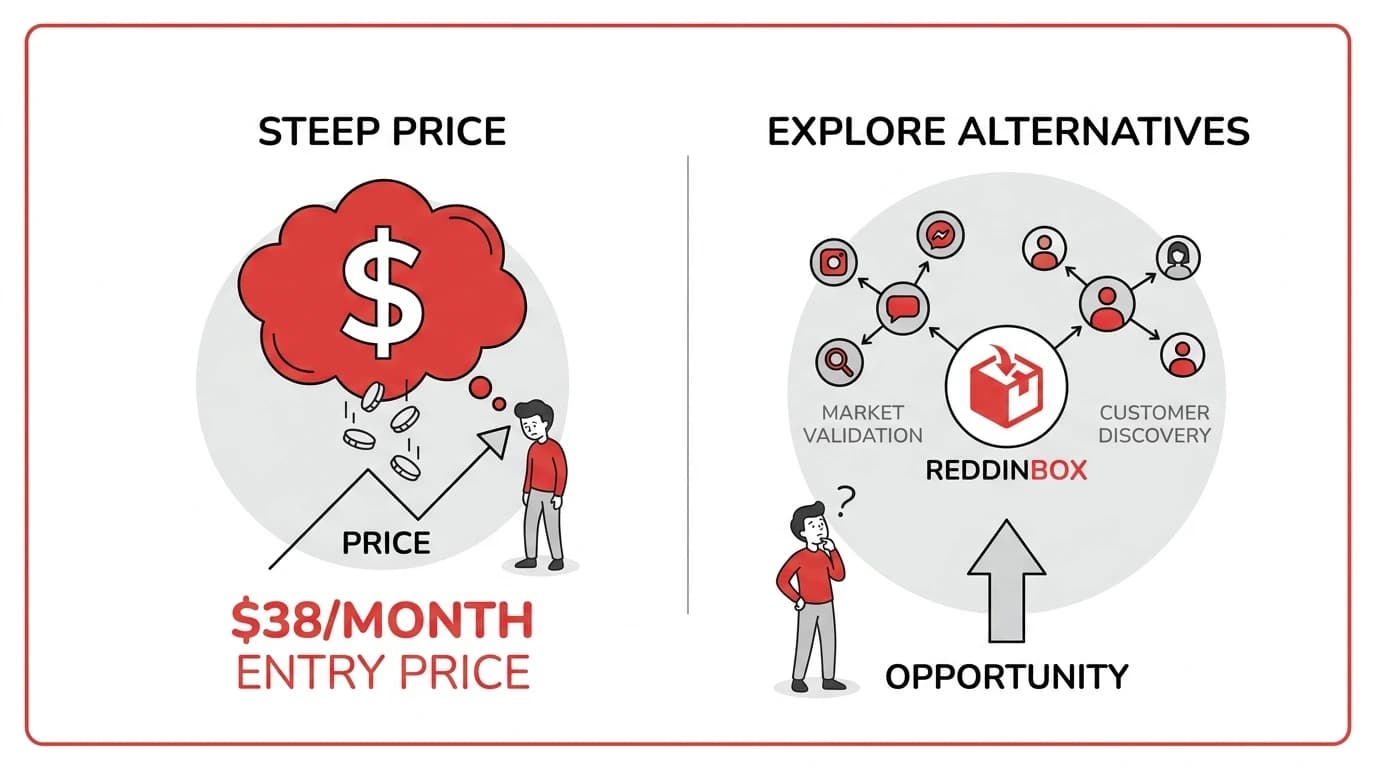
SparkToro costs $38 per month minimum for anything beyond sample results. If you're running a small team or doing occasional audience research, that price tag stings.
You get 50 searches per month on the starter plan, which sounds reasonable at first. But those searches disappear fast when you're doing proper market research.
The tool is good at what it does, but not everyone needs Rand Fishkin's Ferrari. Sometimes you just need to understand your audience without breaking the bank.
You're probably here because:
- SparkToro's pricing doesn't fit your budget
- You need coverage beyond Twitter and web mentions
- You want insights from real conversations, not just follower lists
- You're looking for a tool built for product validation, not just influencer marketing
SparkToro Alternatives at a Glance
| Tool | Data type | Free plan | Starting price (Sep 2026) | Best for |
|---|---|---|---|---|
| Reddinbox | Conversations (Reddit, X, Bluesky, HN, Facebook) | Free trial, no card | $39/month | Product validation, pain points |
| SparkToro (baseline) | Follows, traffic, media consumption | 5 sample searches | $38/month | Influencer discovery, PR outreach |
| Audiense | Social audience segmentation | Demo only | Custom | Deep X/Twitter audience segmentation |
| Similarweb | Web traffic & digital behavior | Limited free tier | ~$125/month | Competitor traffic analysis |
| SEMrush | SEO + traffic + audience | Limited free trial | ~$130/month | Full SEO suite with audience data |
| BuzzSumo | Content trends & influencers | Limited free trial | ~$99/month | Content discovery |
| Brandwatch | Social listening at scale | Demo only | $800+/month | Enterprise social listening |
SparkToro vs Reddinbox: Quick Summary
What Is SparkToro?
SparkToro is an audience intelligence tool founded by Moz creator Rand Fishkin. It shows you where your target audience hangs out online, replacing traditional market research that costs $15,000 to $35,000 with a subscription starting at $38/month.
What SparkToro shows you:
- Podcasts your audience listens to
- Websites they visit
- Who they follow on social media
- YouTube channels they subscribe to
The problems:
- Pricing: $38/month is steep for solopreneurs and small teams
- Search limits: Only 50 searches/month on starter plan
- Missing platforms: Focuses on social metrics, misses Reddit conversations
- Metrics over insights: Shows what people follow, not what frustrates them
How Reddinbox is different:
Reddinbox pulls data from Reddit, X, Bluesky, Hacker News and Facebook (Quora is coming soon) where real conversations happen. An AI agent synthesizes insights from thousands of discussions to help you validate ideas, discover pain points, and conduct market research based on what people actually say.
Other alternatives to consider:
- Audiense: Best for deep X/Twitter audience segmentation
- Similarweb: Best for competitor web traffic analysis
- SEMrush: Best for comprehensive SEO and content marketing
- BuzzSumo: Best for content discovery and influencer marketing
- Brandwatch: Best for enterprise social listening
This SparkToro review and alternatives guide breaks down what works, what doesn't, and how to choose the right tool for your needs.
What SparkToro Does Well (And Why People Use It)
Let's give credit where it's due. SparkToro built something genuinely useful.
Questions SparkToro answers in minutes (not weeks):
- Where does your target audience spend time online?
- What podcasts do they listen to?
- Which YouTube channels do they subscribe to?
- Who influences them on social media?
For marketing agencies juggling multiple clients, that's gold. You can quickly map out an audience's digital footprint without burning hours on manual research.
Why marketers love it:
- Clean interface: Search for a topic, persona, or competitor and get instant results
- Data-backed decisions: Affinity scores, traffic metrics, and relevance indicators
- Perfect for outreach: Know exactly which podcasts to pitch or publications to target
- Trusted source: Rand Fishkin's credibility from Moz transfers to SparkToro
Best use cases:
- Influencer marketing campaigns
- PR outreach targeting
- Link-building strategies
- Competitive audience analysis
The problem isn't that SparkToro is bad. It's expensive, limited in scope, and focused on metrics that don't always translate to actionable insights for product validation.
The Real Problem with SparkToro
SparkToro's limitations aren't dealbreakers for everyone. But they're significant enough that many teams end up looking elsewhere.
1. SparkToro Pricing Creates Barriers
SparkToro pricing in 2026 remains the same structure it's used since launch—and it hasn't gotten easier to justify for small teams.
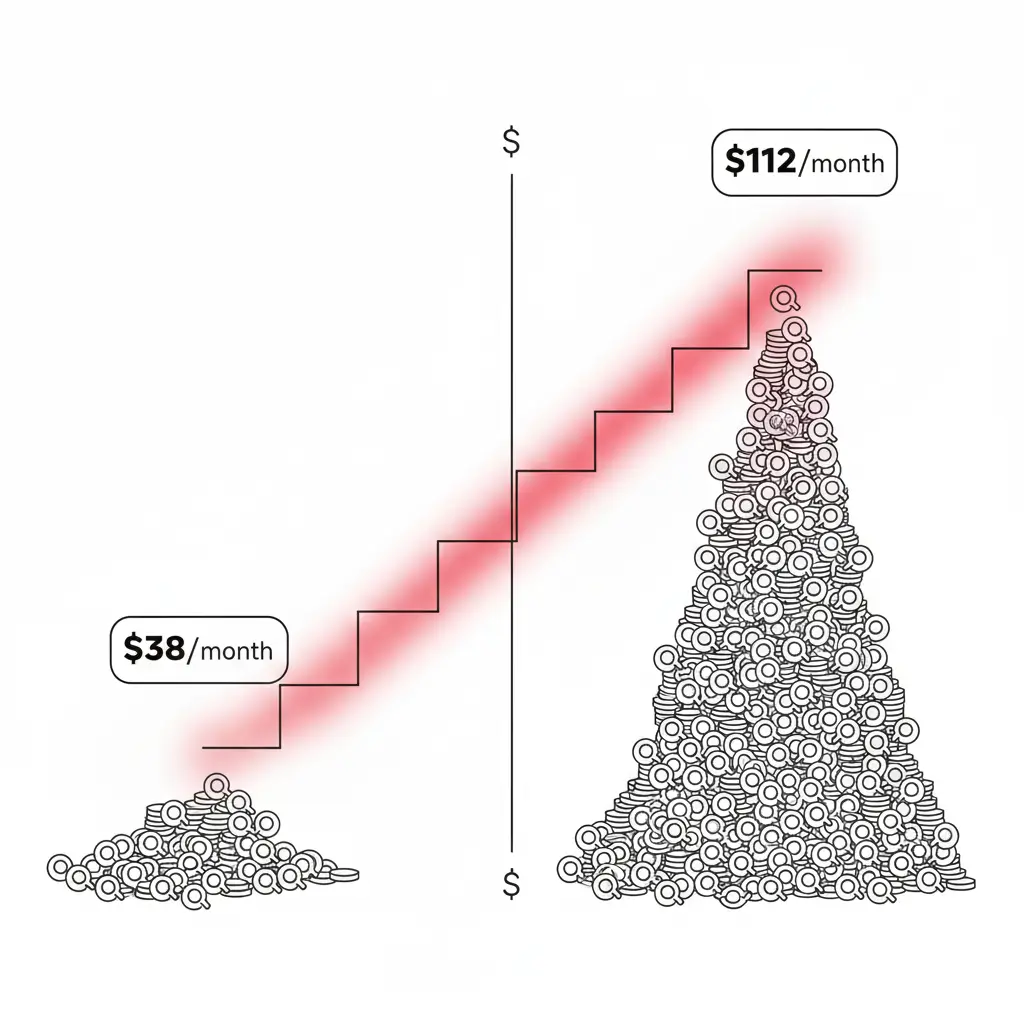
$38 per month gets you 50 searches. That sounds fine until you're researching multiple customer segments or validating different product ideas.
The searches evaporate fast, and suddenly you're looking at the $112/month business plan for 500 searches. For bootstrapped startups or solopreneurs, that's hard to justify.
The free tier offers only 5 searches with sample results. That's basically useless beyond curiosity browsing.
2. Search Quotas Kill Exploration
When every search counts against your limit, you hesitate. Should I use a search on this persona or save it for later?
That friction slows down exploratory research. And exploration is when you discover the most interesting insights.
3. Zero Integrations
SparkToro operates in isolation. You can't pipe data into Google Analytics, connect it to your CRM, or automate workflows.
You're copy-pasting data manually. That feels outdated for a $38–$299/month tool in 2026.
4. Data Accuracy Issues
Multiple reviewers noted instances where SparkToro:
- Showed zero YouTube subscribers for channels with 100K+ subscribers
- Failed to surface social accounts that clearly existed
- Missing obvious influencers in specific niches
When you're paying premium prices, data quality issues are frustrating.
5. Wrong Platforms for Product Validation
What SparkToro shows: Twitter follows, website visits, podcast listens
What you actually need: Conversations where people discuss problems candidly
As a SparkToro audience research tool, it excels at traditional influencer marketing. But it doesn't tap into Reddit threads, Quora discussions, or forum conversations where people vent about what doesn't work.
You get metrics about what people follow publicly. You don't get insights into what frustrates them privately.
That last point is crucial. If you're validating a product idea or understanding customer pain points, you need conversations, not follower lists.
SparkToro pricing tiers (as of September 2026, unchanged since launch):
| Plan | Price | Searches/Month |
|---|---|---|
| Starter | $38/mo | 50 |
| Business | $112/mo | 500 |
| Agency | $299/mo | 2,000 |
| Free | $0 | 5 (sample results) |
Why Modern Audience Research Needs Multi-Platform Coverage
The internet in 2026 isn't centralized around a handful of social networks. Your potential customers are everywhere, and they behave differently on each platform.
How people behave on different platforms:
| Platform | What People Share | Value for Research |
|---|---|---|
| Twitter/X | Polished thoughts, personal branding | Public personas |
| Professional insights, humblebrag posts | Career info | |
| Genuine venting, problem discussions | Real pain points | |
| Quora | Honest questions, detailed answers | Buying intent |
| Forums | Expert debates, solution comparisons | Deep insights |
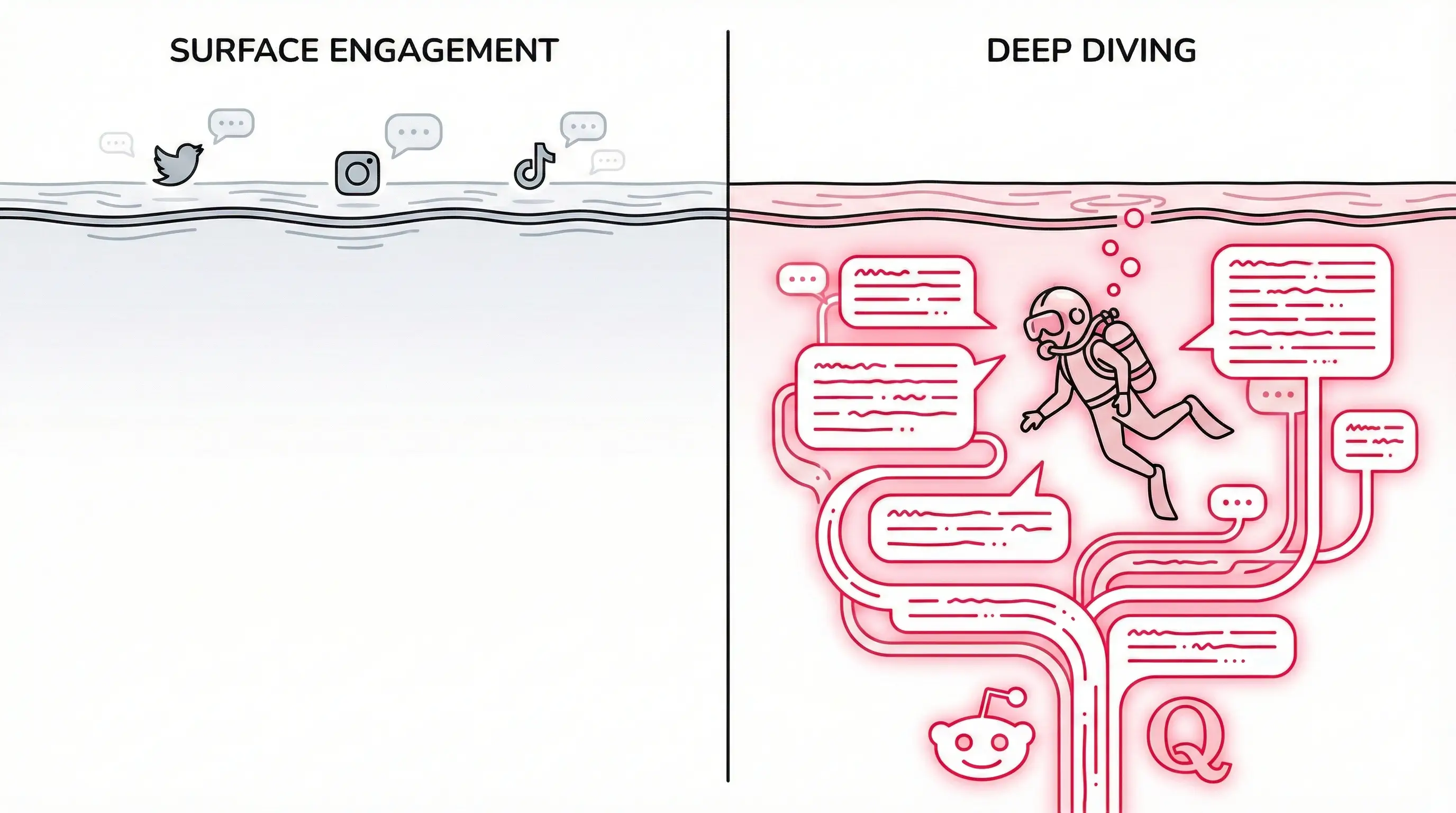
Twitter and LinkedIn show public personas. Reddit, Quora, and forums show the messy reality of what people struggle with.
The "What" vs "Why" Problem
Traditional tools give you the "what":
- This audience follows these accounts
- They visit these websites
- They listen to these podcasts
UGC platforms give you the "why":
- This audience is frustrated because existing solutions don't solve X
- They're willing to pay for Y feature
- Current tools fail at Z use case
For product validation and customer discovery, the "why" matters more. You don't need to know which podcasts your audience listens to when you're trying to figure out if people will pay for your solution.
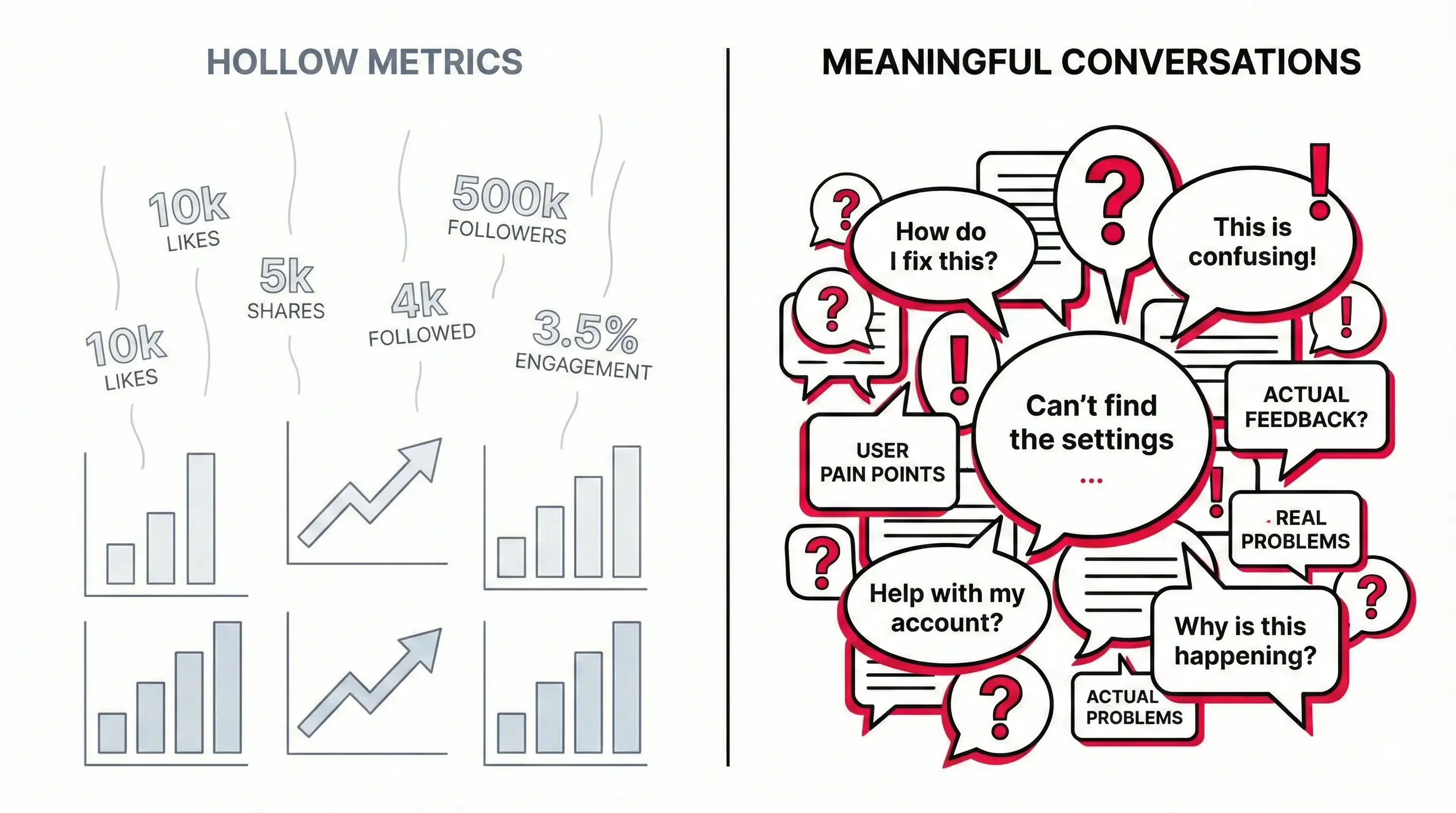
Buying Signals Hide in Conversations
Multi-platform coverage isn't about quantity, it's about diversity of insight. A handful of high-quality Reddit threads beats a list of 100 Twitter influencers.
Real buying signals look like this:
- "I've been searching for a tool that does X but everything sucks"
- "Willing to pay for a solution that actually handles Y"
- "Current tool fails when I try to do Z"
- "What do you use for [your product category]?"
When a Quora thread has 50 answers debating solutions in your category, that's market validation. If your audience tool can't tap into those conversations, you're flying blind.
Reddinbox: A Multi-Platform Alternative Built for Market Intelligence
Reddinbox takes a different approach. Instead of social media follows and podcast listens, it's built around user-generated content platforms where people discuss problems and debate solutions.
Multi-Platform Coverage for Real Conversations
Reddinbox pulls data from Reddit, X, Bluesky, Hacker News and Facebook (Quora is coming soon). When you're researching a market or validating an idea, you see what people actually talk about.
Example: Building a project management tool
SparkToro shows you:
- Your audience follows Asana and Monday.com on Twitter
- They visit project management blogs
- They listen to productivity podcasts
Reddinbox shows you:
- Reddit threads where people complain about what Asana doesn't do well
- X posts and Hacker News threads where people explain why they switched from Monday.com
- Discussions where people describe their ideal workflow
- Buying signals: "Looking for a PM tool that does X"
One gives you awareness data. The other gives you actionable insights.
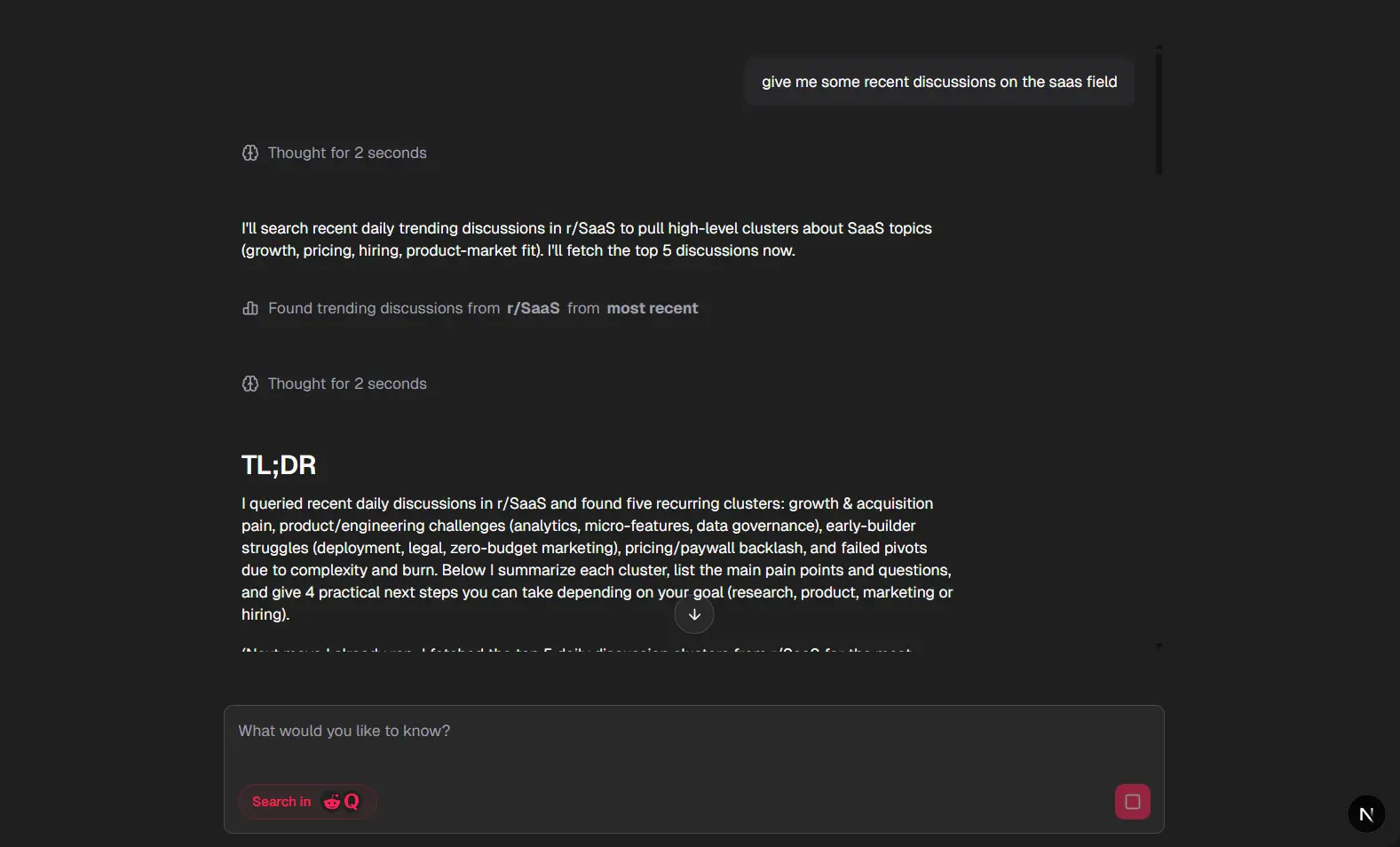
AI Agent Synthesizes Thousands of Conversations
The challenge with user-generated content is volume. Reading hundreds of Reddit threads is time-consuming.
Reddinbox's AI agent solves this by synthesizing insights from thousands of conversations automatically.
Questions you can ask:
- "What are the top pain points people mention about [competitor]?"
- "What features do people wish [product category] had?"
- "Where do people complain about [problem]?"
- "What buying signals exist for [solution]?"
The AI identifies themes, surfaces buying signals, and helps you understand sentiment at scale. You get summaries backed by actual quotes and sources.
You still have access to raw conversations for verification. But the heavy lifting is automated.
Built for Validation, Not Vanity Metrics
Reddinbox isn't a comprehensive marketing platform. It's focused on one thing: helping you understand whether people actually want what you're building.
Perfect for:
- Founders: Validating product ideas with real market demand
- Growth teams: Finding qualified leads and buying signals
- Content teams: Researching topics with real audience pain points
Pricing model: $39/month (Starter, ~100 AI conversations/month) or $99/month (Pro, ~266 AI conversations/month) — capped by conversations rather than a per-search quota, so a single research session can dig as deep as it needs without burning through a search count.
Is it perfect? No tool is. But if your goal is market intelligence based on what people actually say rather than what they publicly follow, it's a fundamentally better approach.
Reddinbox vs SparkToro: Head-to-Head Comparison
| Feature | SparkToro | Reddinbox |
|---|---|---|
| Pricing | $38/mo (50 searches) $112/mo (500 searches) | $39/mo (~100 conversations) $99/mo (~266 conversations) |
| Primary Data Sources | Twitter, podcasts, websites, YouTube | Reddit, X, Bluesky, Hacker News, Facebook (Quora coming soon) |
| Best For | Influencer marketing, PR outreach | Product validation, customer discovery |
| Type of Insights | Follower data, website visits, media consumption | Pain points, buying signals, real conversations |
| AI Analysis | ❌ Manual interpretation | ✅ AI synthesizes insights from thousands of conversations |
| Search Limits | 50-500/month depending on plan | Capped by AI conversations/month, not per search |
| Integrations | ❌ None | ❌ No public API currently |
| Learning Curve | Easy to start | Easy to start |
| Data Format | Metrics and affinity scores | Quotes, themes, and conversation summaries |
| Best Use Cases | - Finding podcasts to pitch - Identifying influencers - Competitor audience analysis | - Validating product ideas - Understanding pain points - Finding qualified leads - Content research |
| Free Trial | 5 searches (sample results) | Free trial, no credit card |
Choose SparkToro if: You need influencer discovery, PR outreach targets, or traditional audience demographics.
Choose Reddinbox if: You need product validation, customer pain points, buying signals, or conversational market intelligence.
Best SparkToro Alternative for AI Search (AEO) Research
There's a use case SparkToro doesn't address at all: understanding what questions people ask AI systems like ChatGPT and Perplexity, and what language triggers an authoritative-sounding answer. That's Answer Engine Optimization (AEO) research, and it's a fast-growing reason people search for SparkToro alternatives.
SparkToro's data (social follows, podcast listens, website visits) doesn't map to this. Knowing which podcasts your audience listens to tells you nothing about how they'd phrase a question to an AI assistant.
Reddit is disproportionately useful here because AI systems heavily index long-form Q&A threads and community discussions when generating answers — a well-upvoted Reddit thread debating solutions in a category often shapes what ChatGPT or Perplexity says about that category. Tools built around forum conversations, rather than audience demographics, are the closer fit:
- Reddinbox surfaces the exact questions and phrasings your audience uses in Reddit discussions, which maps closely to what they'd type into an AI search interface — and gives you a source link back to the original thread for every insight.
- Manual Reddit search works for a single AEO research pass, but doesn't scale across multiple topics or ongoing monitoring the way an AI agent does.
If AEO is your primary driver for looking past SparkToro, this is the gap to prioritize closing — traditional audience intelligence data won't get you there.
Other SparkToro Alternatives Worth Considering
Reddinbox isn't the only game in town. Depending on your needs, other alternatives might be better fits.
Audiense - Best for Deep X/Twitter Audience Segmentation
Audiense is a genuine audience-intelligence competitor to SparkToro, not just a general marketing platform. It builds detailed audience segments and interest graphs primarily from X/Twitter data, with demographic and psychographic breakdowns that go deeper than SparkToro's affinity scores.
Key features:
- Audience segmentation by interests, demographics and behavior
- Conversation and influencer mapping on X
- Campaign planning tools built around those segments
Pricing: Custom, sold through a sales process rather than self-serve. Best for: Teams whose audience research is heavily X/Twitter-centric and need segmentation depth, not just discovery.
Similarweb - Best for Competitor Web Traffic Analysis
Similarweb answers a different question than SparkToro: not who your audience follows, but where they go and what they do online. It's the closest audience-intelligence competitor for traffic-based research — competitor site traffic, referral sources, and audience overlap between domains.
Key features:
- Website traffic and engagement estimates for any domain
- Audience overlap and cross-visitation data
- Industry and competitor benchmarking
Pricing: Free tier with limited data; paid plans start around $125/month. Best for: Teams that need competitive traffic intelligence alongside, or instead of, social audience data.
SEMrush - Best for SEO + Audience Intelligence
The Swiss Army knife of digital marketing. If you need audience intelligence alongside SEO tools, PPC research, and competitive analysis, it's hard to beat.
Key features:
- Market Explorer for discovering new markets
- Competitor performance tracking
- Keyword research and SEO tools
- Traffic analytics
Pricing: Starts around $130/month Best for: Teams using the full SEO suite, not just audience research
BuzzSumo - Best for Content Marketing
Great for content marketers who need discovery, monitoring, and insights in one platform.
Key features:
- Trending topic identification
- Influencer discovery for content partnerships
- Content performance tracking
- Social media monitoring
Best for: Content marketing workflows, not pure audience intelligence
Brandwatch - Best for Enterprise Social Listening
Enterprise-grade social listening at scale. If you need to monitor brand mentions and track sentiment across platforms, Brandwatch has the horsepower — see the Brandwatch alternatives comparison for cheaper options at a similar depth.
Best for: Agencies and large companies managing multiple brands Drawback: Overkill (and overpriced) for small teams
Where to Read More Before Deciding
For deeper research, platforms like G2 and TrustRadius aggregate thousands of user reviews across competing tools, while Backlinko's detailed analysis breaks down SparkToro's specific strengths and weaknesses. These resources help you evaluate tools based on your industry and use case.
For Reddit-specific research once you've picked a direction, the Reddit audience research guide and the free subreddit finder are good next steps regardless of which paid tool you land on.
The key: Match the tool to your actual workflow. SEMrush for SEO, Brandwatch for social listening, Reddinbox for product validation.
How to Choose the Right Alternative
Picking an audience intelligence tool isn't about finding "the best" option. It's about finding the right fit.
1. Start with Your Primary Use Case
Different tools excel at different things. Be honest about what you actually need.
Use case matching:
- Influencer discovery: SparkToro
- Product validation: Reddinbox
- SEO + content marketing: SEMrush
- Content discovery: BuzzSumo
- Enterprise social listening: Brandwatch
2. Consider Your Budget and Team Size
If you're a solopreneur doing occasional research, $112/month doesn't make sense. Look for tools with pricing that matches your usage patterns.
Pricing models to consider:
- Per-search limits (SparkToro)
- Unlimited usage (Reddinbox)
- Bundled with other tools (SEMrush)
3. Evaluate Platform Coverage
The platform coverage determines the type of insights you'll get.
| Your Need | Platform Focus |
|---|---|
| Social media metrics, podcast listens | SparkToro |
| Real conversations, pain points | Reddinbox |
| SEO data, traffic analysis | SEMrush |
| Content trends, viral posts | BuzzSumo |
4. Check Integration Requirements
If you need to pipe audience data into your CRM or marketing automation platform, verify integration support. Some tools operate in isolation.
Questions to ask:
- Does it have an API?
- Can it export data in usable formats?
- Does it connect with our existing stack?
5. Test During a Trial Period
Most tools offer free trials. Use them for a real research project, not just poking around.
Evaluation checklist:
- ✅ Can you get actionable insights?
- ✅ Is the interface intuitive?
- ✅ Does data quality hold up?
- ✅ Does it answer your specific questions?
A week of real usage tells you more than any feature comparison chart.
6. Think About Scalability
If you're a solo founder today but planning to build a team, consider whether the tool scales with you.
Red flags:
- Per-search pricing that gets expensive fast
- No team features
- Limited collaboration options
Good signs:
- Unlimited usage plans
- Seat-based pricing
- Team collaboration features
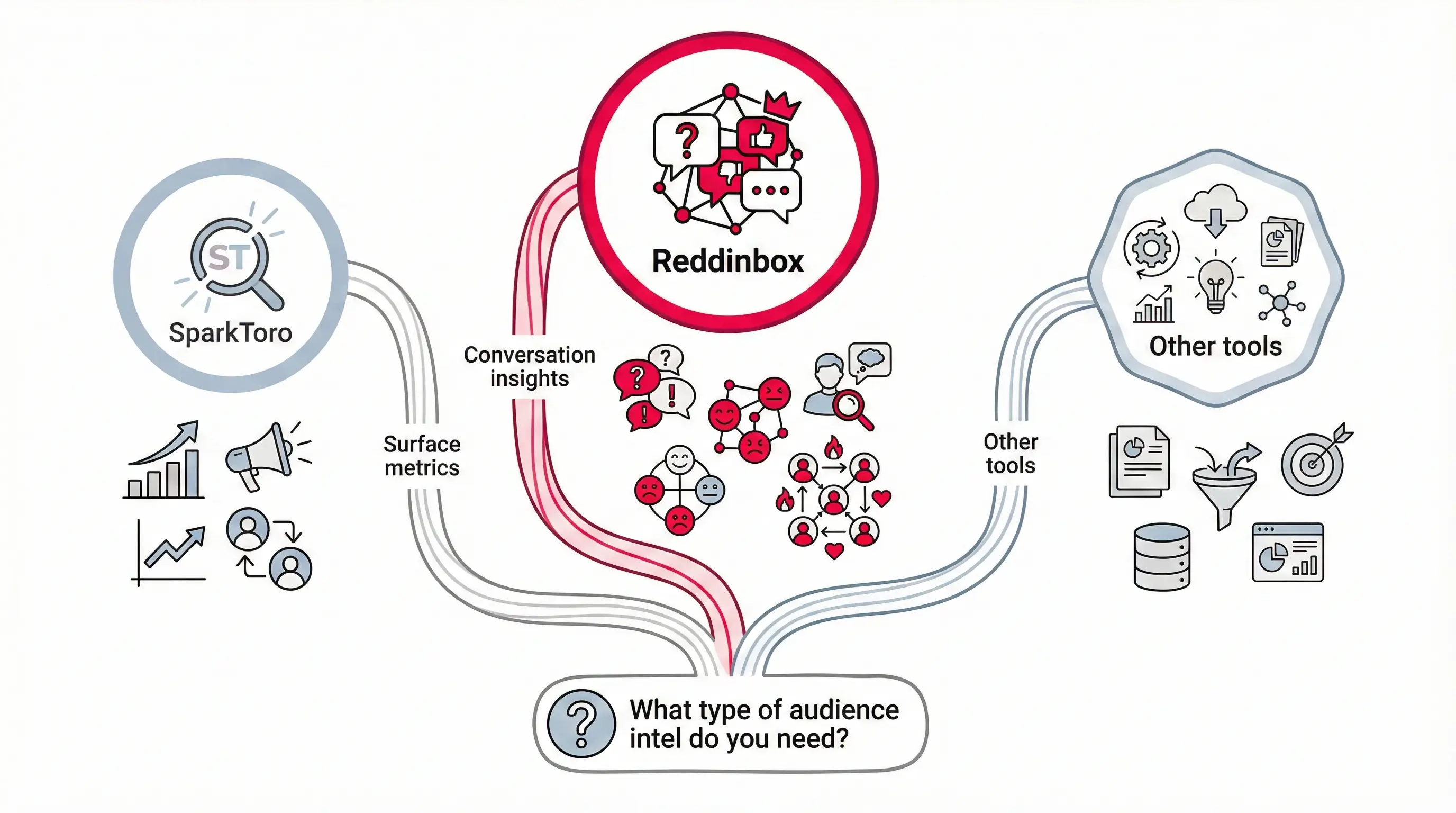
The worst decision: Buying a tool because it's popular without thinking through whether it solves your specific problem. A simpler, cheaper tool that fits your workflow perfectly beats a feature-rich platform you barely use.
Frequently Asked Questions
Can AI-based research tools replace specialized audience intelligence platforms like SparkToro?
Not entirely, but they close the gap significantly. SparkToro aggregates behavioral data (podcast listens, website visits, social follows) at scale from a proprietary dataset. AI tools like Reddinbox analyze conversations from public UGC platforms and synthesize patterns from thousands of threads.
The difference is in what you're trying to learn. If you need demographic breadcrumbs, who they follow, what media they consume, SparkToro has an edge. If you need to understand why people switch tools, what they're frustrated with, or whether a market exists for your idea, AI-powered conversation analysis is more useful. For most product and growth teams, the latter is the more pressing question.
Can SEMrush or Ahrefs replace SparkToro for audience research?
Partially, and only for specific use cases. SEMrush and Ahrefs are fundamentally SEO and competitive intelligence platforms. They'll tell you which keywords your audience searches, what content performs well, and where competitors get their traffic.
What they won't tell you is what podcasts your audience listens to or which social accounts they follow, that's SparkToro's core value. And neither platform surfaces the conversational signals you get from Reddit. Use SEMrush when you need SEO data alongside broad audience behavior. Don't use it as a direct SparkToro substitute for influencer discovery or conversation research.
Are there free or low-cost alternatives for audience intelligence?
Yes, with trade-offs:
- Google Analytics , Best free option if you already have site traffic. Strong demographic and behavioral data for your existing audience, nothing for cold market research.
- Reddit directly , Free but manual and time-consuming. No synthesis or pattern detection.
- Reddinbox , Automates the manual Reddit research with AI synthesis. Paid, from $39/month, with a free trial.
- SparkToro free tier , 5 sample searches. Enough to demo the concept, not enough for real research.
For bootstrapped startups, the practical free stack is Google Analytics (owned audience) + manual Reddit searches (cold market research). The moment that manual process becomes a bottleneck, a paid tool earns its cost.
What gaps do free SparkToro alternatives typically have?
The main gaps are data breadth, freshness, and synthesis. Free tools typically:
- Lack proprietary datasets (SparkToro aggregates data not publicly available)
- Require manual effort to pull and analyze information
- Don't surface cross-platform patterns automatically
- Miss long-tail influencers and niche communities
The synthesis gap is the most painful. Reading raw Reddit threads is doable for one research task. It doesn't scale across multiple segments, multiple markets, or ongoing monitoring. That's where paid tools justify their cost.
Does SparkToro cover Reddit?
Not directly. SparkToro (also written "Spark Toro") focuses on social follows, website visits, podcast listens and YouTube subscriptions — it doesn't surface Reddit threads or conversations. If Reddit is where your audience actually talks, a tool built around community conversations, like Reddinbox, covers that gap.
Is SparkToro worth it in 2026?
Yes, for its core use case — influencer discovery, PR outreach targeting and traditional audience demographics, especially for marketing agencies. It's a weaker fit if your primary need is understanding why people are frustrated with a category or validating a product idea, since it doesn't tap into conversational data.
Are there tools better suited for Answer Engine Optimization (AEO) research?
Yes, and this is an underrated use case — see the full AEO section above for more detail. AEO research means understanding what questions people ask in AI search engines like Perplexity or ChatGPT, and what language triggers authoritative answers.
Reddit is particularly valuable here, since AI systems heavily index long-form Q&A content and community discussions. Reddinbox surfaces the specific questions and phrasings your audience uses in those threads, which maps closely to what they'll type into an AI search interface.
Traditional SparkToro-style audience data (social follows, podcast listens) doesn't help with AEO directly. For AEO research specifically, tools that surface verbatim questions from forums and Q&A platforms are a better fit than audience demographic tools.
Is it worth paying for a premium audience research tool, or can manual methods work?
It depends on how often you do research and what's at stake. Manual methods, searching Reddit, scanning Quora, reading forums, are free and often produce good insights. They just don't scale.
The math is straightforward: if you spend 8 hours manually researching a market and your time is worth $50/hour, that's $400 of research. A $38/month subscription pays for itself in under an hour of saved time per month.
The stronger argument for paid tools is consistency. Manual research is something you do once. Tooling makes it repeatable, so you can validate multiple ideas, track shifting sentiment, or do ongoing competitive monitoring without it becoming a project.
Wrapping Up
SparkToro is a solid tool for influencer marketing and PR outreach. Rand Fishkin built something genuinely useful, and for teams with budget and the right use cases, it delivers value.
But the $38/month entry price, search limits, and focus on social metrics make it a poor fit for many teams. If you're doing product validation or customer discovery where understanding pain points matters more than follower counts, you need a different approach.
Quick Decision Guide
Choose SparkToro if you need:
- Influencer discovery for partnerships
- PR outreach targeting
- Podcast pitching opportunities
- Traditional audience demographics
Choose Reddinbox if you need:
- Product validation with real market demand
- Customer pain point discovery
- Buying signals and qualified leads
- Conversational market intelligence
Choose SEMrush if you need:
- Comprehensive SEO tooling
- Keyword research + audience insights
- Competitor traffic analysis
Choose BuzzSumo if you need:
- Content trend identification
- Social media performance tracking
- Viral content discovery
The Bottom Line
Reddinbox offers multi-platform audience intelligence built around real conversations, not follower lists. Instead of showing you who your audience follows on Twitter, it shows you what they're complaining about on Reddit.
That's fundamentally more useful for building products and finding customers — try the Reddit AI search to see the agent workflow in action.
The worst outcome is paying for a tool you don't use because the pricing model, platform coverage, or workflow doesn't match your needs. Most tools offer trials, a week of real usage tells you everything you need to know.
If you're serious about understanding your audience based on what they actually say rather than what they publicly follow, check out Reddinbox. It's built for a different kind of audience intelligence, one that helps you make better product and marketing decisions.